

In SAP EWM, sort rules for warehouse tasks in the RF screen determine the sequence in which tasks appear when operators confirm picks or put-aways using RF devices. Without a correctly configured sort rule, the system defaults to warehouse order number sequencing — which rarely matches the physical layout of storage bins. This guide explains how to define sort rules, assign sort fields, and link them to warehouse order creation rules so that the RF screen reflects the same bin-based ordering as the warehouse monitor.
Sort rules in SAP Extended Warehouse Management (EWM) control the display order of warehouse tasks in both the warehouse monitor and the RF screen during task confirmation. When a picker works on a warehouse order through the Selection by WO RF screen, the system lists open warehouse tasks in a defined sequence. If no sort rule is assigned, tasks appear in numeric order by warehouse task number — not by physical storage bin location.
This misalignment forces pickers to travel back and forth across the warehouse rather than following an optimised pick path. A properly configured sort rule aligns the RF screen task sequence with the actual bin layout, reducing travel time and confirmation errors. In high-volume warehouses, this configuration alone can reduce pick cycle times by 10–20%.
This implementation applies specifically to RF screens that include warehouse task confirmation steps. It is not applicable to RF transactions that do not involve confirmation of warehouse tasks.
The following configuration walkthrough uses an example where a user wants warehouse tasks in the Selection by WO screen sorted by source storage bin rather than warehouse task number. The warehouse order in this example is 2000029680 and the warehouse number is CHM1.
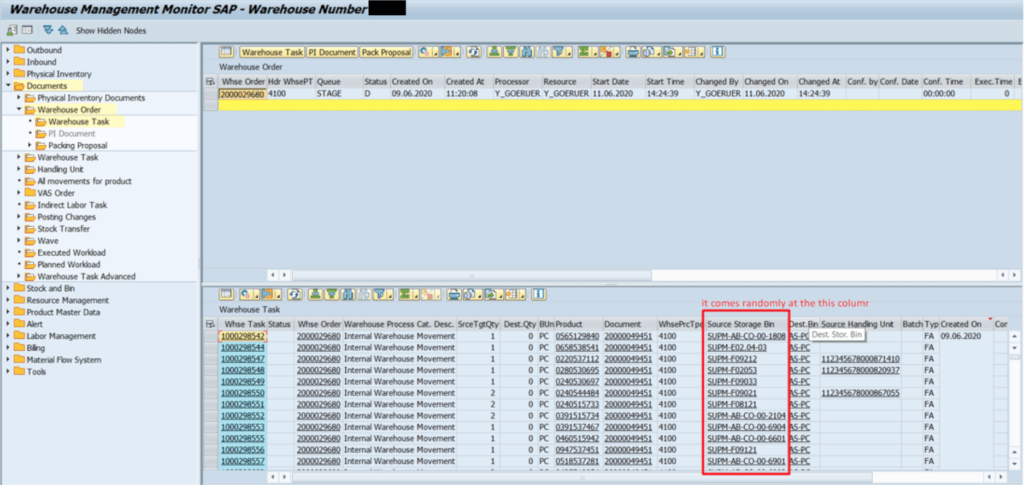
Without a sort rule, warehouse tasks in the RF screen are listed in the same numeric order as the warehouse monitor — not by source storage bin.
The first step is to create a sort rule code and assign it to a warehouse number. Navigate to the following SPRO path:
SPRO → SCM EWM → EWM Cross-Process Settings → Warehouse Order → Define Sort Rules for Warehouse Task → Define Sort RulesIn this example, create the sort rule with the following values:
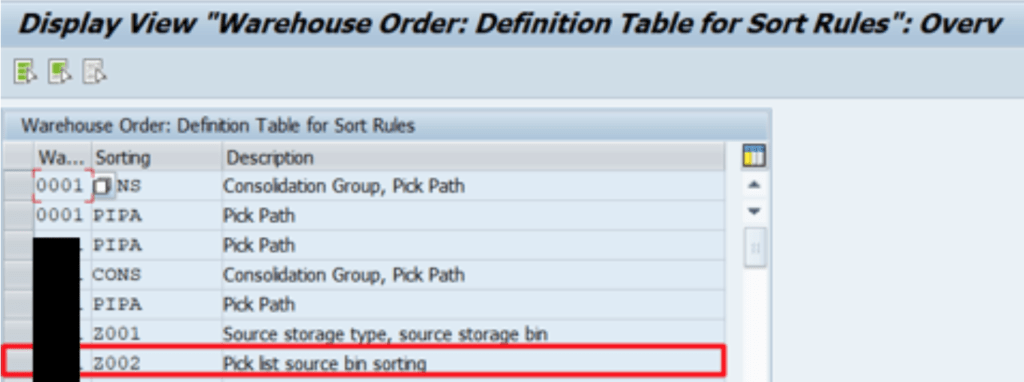
After creating the sort rule, assign the field names that the system will use to determine sort order. Navigate to:
SPRO → SCM EWM → EWM Cross-Process Settings → Warehouse Order → Define Sort Rules for Warehouse Task → Define Sort FieldsAssign the following values for the new sort rule:
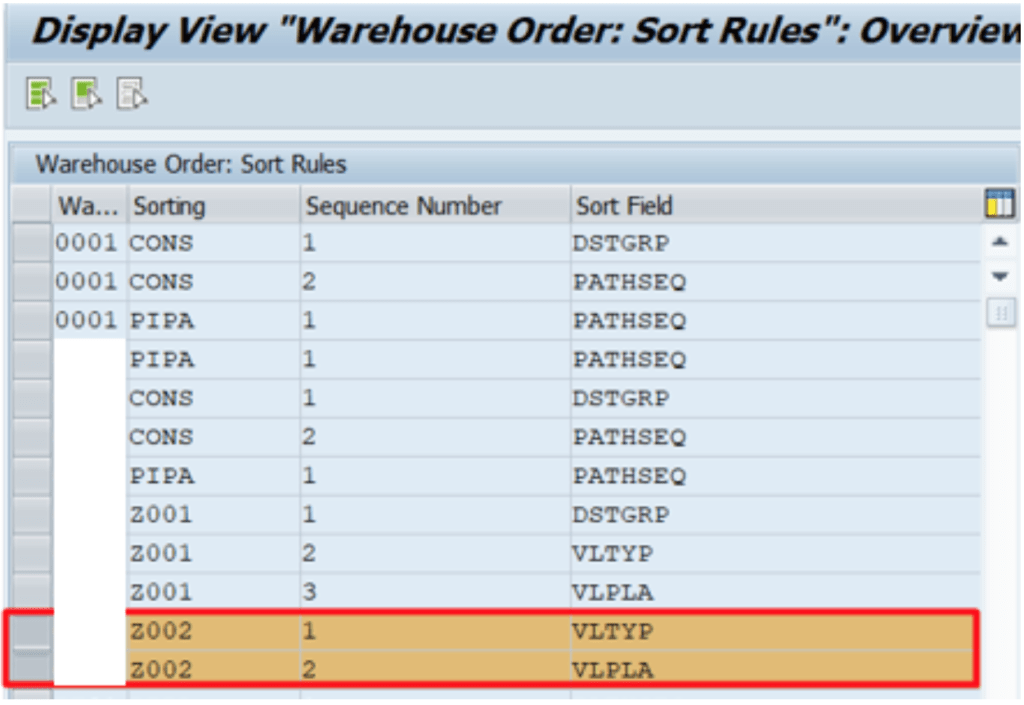
Using VLTYP as sequence 1 and VLPLA as sequence 2 ensures that tasks are first grouped by storage type, then sorted by bin within each type.
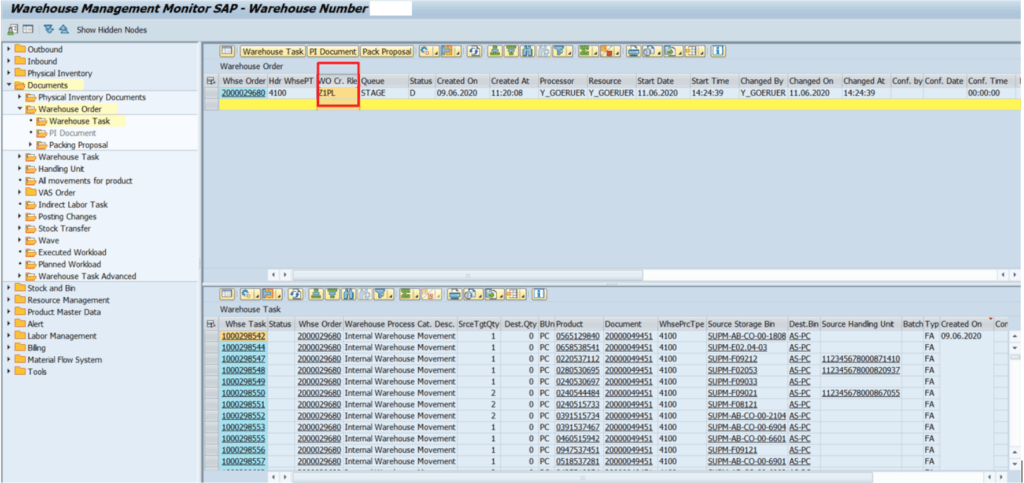
The sort rule must be linked to the relevant Warehouse Order (WO) Creation Rule. Check the warehouse monitor to identify which creation rule applies to your warehouse orders. In this example, the WO creation rule is Z1PL.
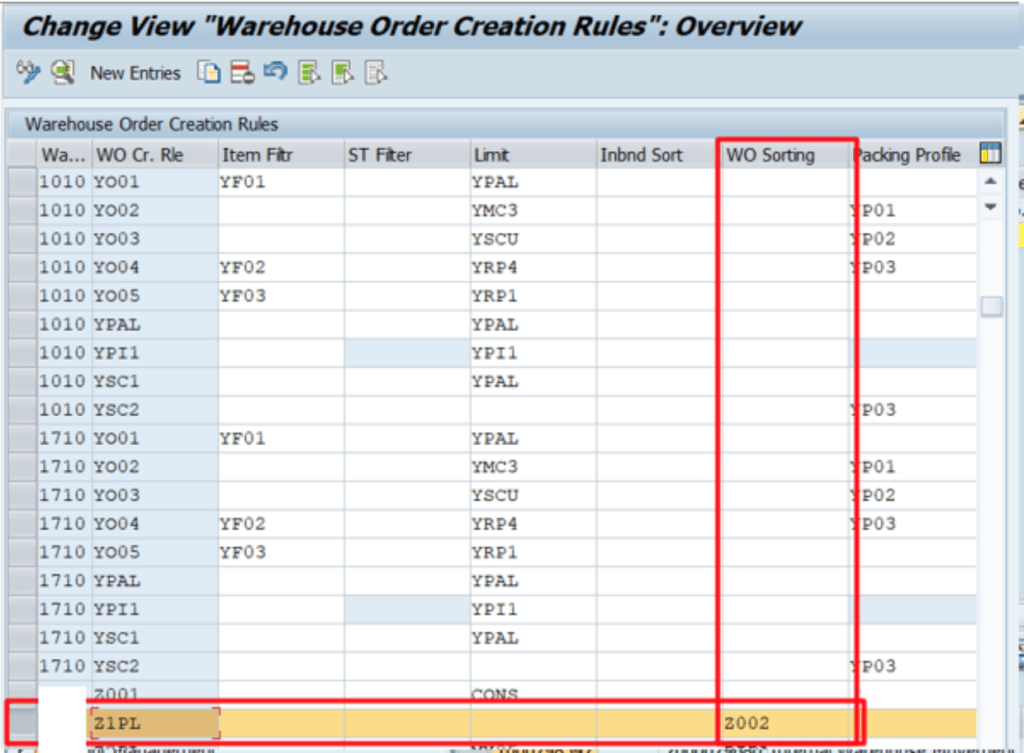
Navigate to the WO Creation Rule configuration and enter Z002 in the WO Sorting column for rule Z1PL.
After completing all three configuration steps, apply a bin-based sort in the warehouse monitor (smallest to largest bin number) and check the RF screen. The warehouse task sequence in the RF should now match the monitor sort order.
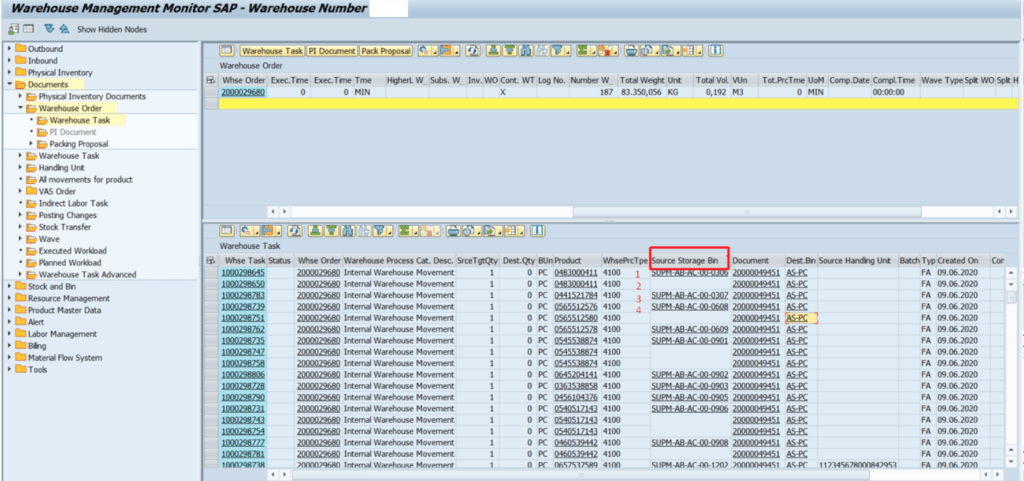
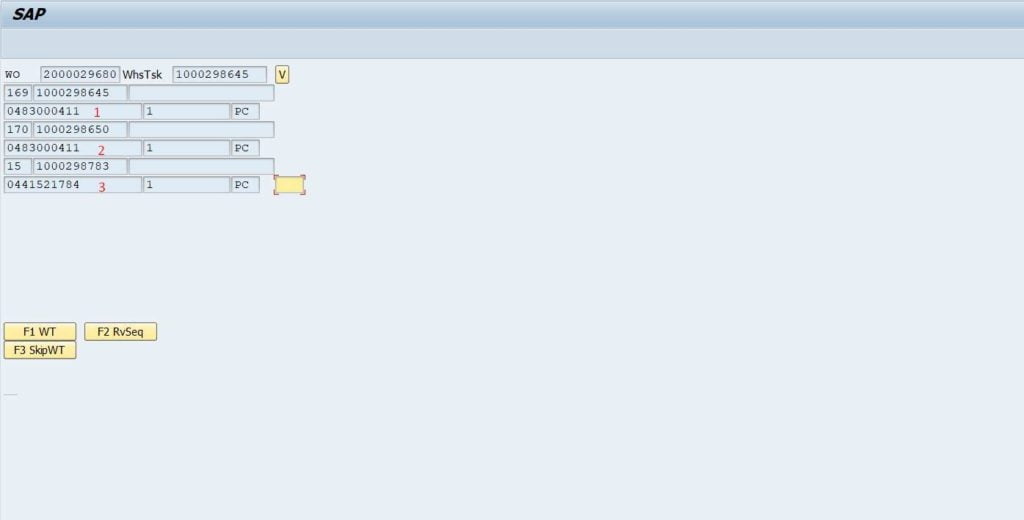
The RF screen now lists warehouse tasks in the same source bin sequence as the warehouse monitor. Pickers follow a logical, bin-ordered path rather than jumping between locations.
Assigning sort fields in the wrong sequence. If VLPLA (bin) is set as sequence 1 and VLTYP (type) as sequence 2, the system sorts by bin number across all storage types without grouping by type first. This can produce unexpected ordering in warehouses with multiple storage types.
Forgetting to link the sort rule to the WO creation rule. Defining sort rules and sort fields without completing Step 3 means the sort rule is never applied. The RF screen will continue to display tasks in default order.
Applying this to non-confirmation RF screens. Sort rules only affect RF screens that include warehouse task confirmation steps. Inquiry-only or transfer-order RF screens are not impacted by this configuration.
Not testing with an actual warehouse order. Always verify the result using a real warehouse order in a test environment before applying to production. Confirm both the monitor sort and the RF screen display match your expected bin sequence.
For a broader overview of how SAP EWM with RFUI supports efficient warehouse management, including additional RF screen configuration topics, refer to our dedicated guide.
Does this configuration affect all RF screens or only specific ones?
Sort rules for warehouse tasks apply only to RF screens that include warehouse task confirmation steps, such as Selection by WO. RF screens that display information without requiring confirmation are not affected by this configuration.
Can I define multiple sort rules for the same warehouse number?
Yes. You can create multiple sort rules (for example, Z001 for bin sorting and Z002 for product sorting) and assign different rules to different WO creation rules. This lets you apply different RF screen sequences for different warehouse processes within the same warehouse number.
What is the difference between VLTYP and VLPLA sort fields?
VLTYP refers to the Storage Type (a logical grouping of storage bins, such as a high-rack area or a floor storage zone). VLPLA refers to the individual Storage Bin within a storage type. Using both fields in sequence ensures tasks are first grouped by storage area, then sorted by bin within each area — producing the most efficient pick path.
Will this configuration change how tasks appear in the warehouse monitor?
No. The sort rule assigned to the WO creation rule controls the RF screen display sequence. The warehouse monitor has its own independent sort controls. However, for verification purposes, it is useful to set the monitor sort to match the expected RF sequence when testing this configuration.
Does this work in both Embedded EWM and Decentralised EWM?
Yes. The SPRO path and configuration logic are the same in both Embedded SAP EWM (integrated with S/4HANA) and Decentralised EWM deployments. For Embedded EWM setup details, refer to our Embedded SAP EWM Client BASIS Implementation guide.
SAP Extended Warehouse Management — SAP Help Portal
What is SAP Extended Warehouse Management (SAP EWM)? — MDP Group
Using SAP EWM with RFUI for Efficient Warehouse Management — MDP Group

SAP EWM Consultant
Your mail has been sent successfully. You will be contacted as soon as possible.
Your message could not be delivered! Please try again later.