Introduction
Sustainability is no longer a footnote tucked into the last page of corporate reports it is an operational parameter that directly influences supply chain decisions. Regulations such as the EU's CSRD (Corporate Sustainability Reporting Directive) and CBAM (Carbon Border Adjustment Mechanism) are compelling companies to substantiate their transportation-related emissions with concrete data.
Logistics operations account for roughly 8% of global carbon emissions. That figure alone places the sector squarely in the crosshairs of emission reduction pressure.
SAP Transportation Management (SAP TM) provides infrastructure for calculating these emissions alongside its transportation planning and execution capabilities but as with any tool, understanding its boundaries is just as important as knowing its strengths.
In this article, we will examine SAP TM's carbon emission calculation framework in technical detail, drawing on real project experience, and we will be upfront about what it can and cannot do.
SAP Transportation Management offers a structured and technically robust framework for calculating transportation-related carbon emissions within logistics processes. It enables companies to generate estimated CO₂e values based on distance, vehicle type, load factor, and defined emission factors, supporting regulatory and reporting requirements. However, SAP TM is not a turnkey sustainability solution. Its accuracy depends entirely on master data quality, emission factor maintenance, and correct configuration. Emission values serve primarily as reporting and analytical inputs rather than automated optimization drivers. To extract real value, organizations must treat SAP TM’s emission engine as a configurable framework that requires governance, integration effort, and continuous calibration.
What Does Carbon Emission Calculation Cover in SAP TM?
Emission calculation in SAP TM refers to producing estimated greenhouse gas (GHG) values generated during transportation activities. The word "estimated" deserves emphasis here: the system does not consume real-time fuel consumption data. Instead, it generates a projection based on predefined emission factors and transportation parameters.
The key inputs feeding the calculation are:
- Transportation mode: Road, ocean, air, rail
- Distance: Route distance calculated by the system or entered manually
- Vehicle type: Truck class, vessel type, aircraft model, etc.
- Payload weight or volume: Gross weight/volume on the Freight Order
- Emission factors: Per-unit emission values defined by the user in the system (e.g., gCO₂/tkm)
With the resulting output, companies can:
- View CO₂e (carbon dioxide equivalent) values per shipment,
- Compare the emission impact of alternative transportation plans,
- Feed this data into corporate sustainability reporting as a structured input.
How Does SAP TM Calculate Carbon Emissions?
1. The Level at Which Calculation Is Triggered
Emission calculation is triggered at the Freight Order (FO) or Freight Booking level. When a Freight Order is created or updated, the system can run the emission calculation either automatically or manually, depending on the configuration.
In multi-leg shipments, a separate calculation is performed for each leg/stage, and the total emission is consolidated at the FO level. However, there is an important detail here: allocation logic. If a vehicle carries multiple shipments, how the emission is distributed across loads (weight-based, volume-based, equal distribution) must be configured correctly. This is a point frequently overlooked during implementations.
2. Calculation Formula and Logic
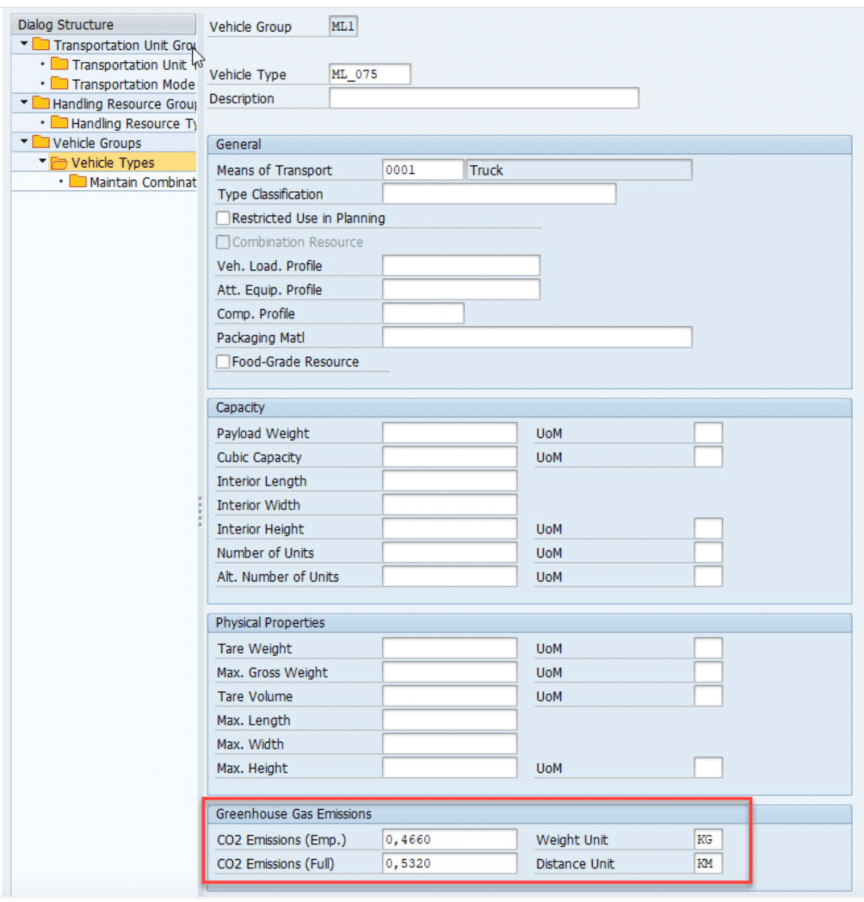
Emission calculation parameters in SAP TM are configured through Vehicle Types.