

In today's rapidly evolving landscape of warehouse management, the integration of cutting-edge technologies is inevitable for staying competitive. In this blog post, we aim to explain the revolutionary realm of Generative AI and its transformative impact on warehouse operations. From optimizing inventory management to enhancing order fulfillment processes, Generative AI offers a dynamic solution to the complex challenges faced in modern warehouses.

Generative AI, or Generative Artificial Intelligence, is a branch of AI that focuses on creating new data rather than just analyzing existing data or making predictions based on it. Unlike earlier generations of AI and machine learning, which primarily relied on learning patterns from large datasets through supervised or unsupervised methods, generative AI has the ability to generate new content, such as images, text, or even entire scenarios, based on its understanding of the underlying patterns in the data it has been trained on. This innovation marks a significant shift from simply recognizing and processing existing information to creating entirely new and original content.
Adopting Generative AI in warehouse operations means bringing in a smart technology that can make things work better and faster. Imagine a warehouse like a giant puzzle, with lots of boxes and items that need to be sorted, moved, and shipped out. Generative AI helps solve this puzzle by using its brainpower to figure out the best ways to organize everything. It can predict when more items will be needed, where they should go, and even how to get them there most efficiently. This means fewer mistakes and delays, and happier customers who get their orders on time.

One of the most significant feature of Generative AI is that it can learn and adapt as it goes along. It's like having a super-smart assistant who keeps getting better at their job every day. For example, if there's a sudden rush of orders for a particular product, Generative AI can quickly adjust the warehouse layout to make sure those items are easy to find and ship out fast. It's all about being flexible and staying ahead of the game in a fast-paced world.
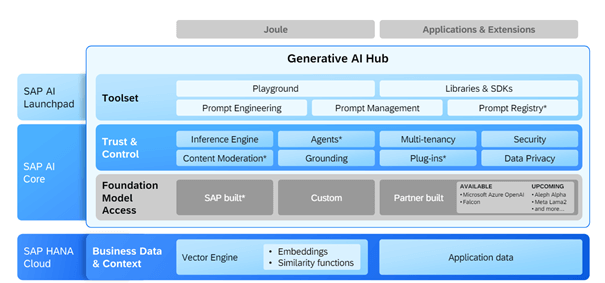
Thanks to current SAP Solutions and SAP Road Map on AI, customers can easily adapt to continiously growing world of AI in multiple businesses and make use of the power of generative AI to create business plans and instantly discover insights in SAP Analytics Cloud with Joule copilot.
SAP Business AI enables accessing and extending with generative AI built upon leading foundation models, and orchestrate multiple large language models (LLMs) from one central location. It offers various efficient tools, prompt engineering, experimentation, and optimization while leveraging vector capabilities for accurate data retrieval and reduced errors.
In your warehouse operations you can transform your supply chain with AI-driven insights, recommendations, and automation integrated into supply chain solutions from SAP. With SAP Business AI, you can predict events, make better informed decisions, and modernize functions from design to operate.
References
Generative AI at SAP by Sean Kask, Hadi Hares, Jana Richter
https://www.sap.com/products/artificial-intelligence/supply-chain.html

SAP EWM/TM Consultant
As a consultant specializing in SAP logistics modules, I provide end-to-end solutions in warehouse operations, shipment planning, and freight cost management processes. I actively participate in system design and integration projects that increase operational efficiency and optimize costs, primarily focusing on SAP EWM and TM.
Your mail has been sent successfully. You will be contacted as soon as possible.
Your message could not be delivered! Please try again later.