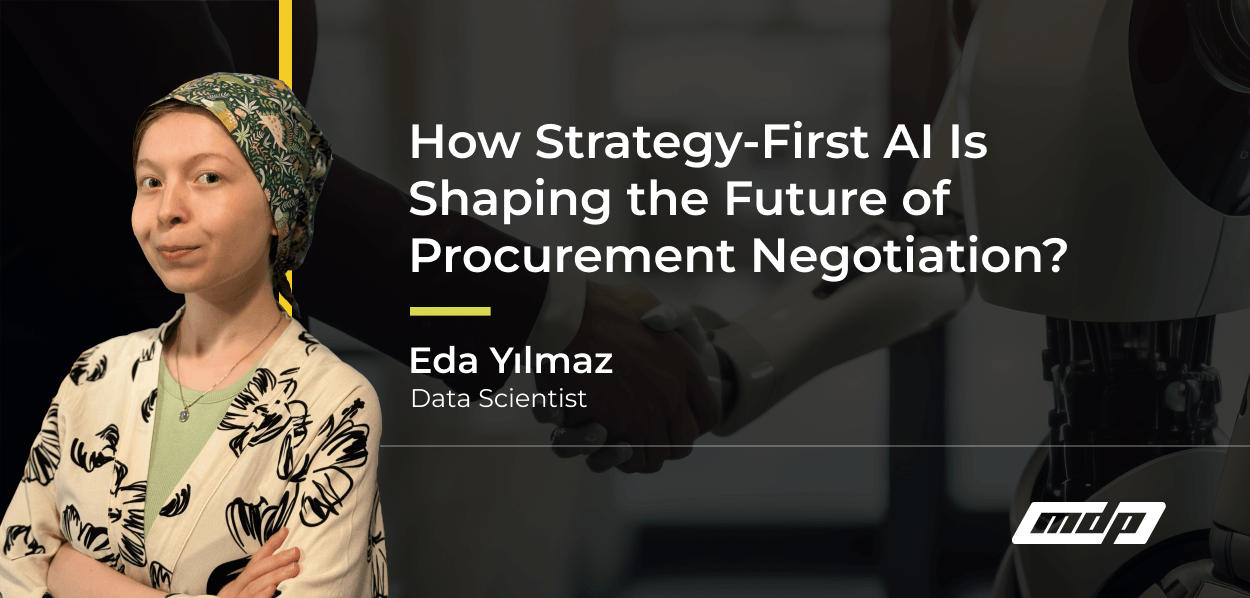
The Art of Negotiation with AI
Moving beyond automated emails toward strategy-first, policy-bound procurement intelligence.
In today's fast-paced digital economy, supply chain management and procurement remain surprisingly reliant on manual execution. Supplier offers get buried in email threads, negotiation histories are locked in fragmented spreadsheets, and critical purchasing decisions are too often left to individual judgment. This scattered approach drains valuable time and quietly erodes margins.
Which raises a fundamental question: does simply migrating manual processes to digital tools solve the core problem?
At MDP Group, drawing over 15 years of SAP and digital transformation expertise, we believe digital transformation is only complete when processes become genuinely intelligent. This philosophy drove the development of JetSRM, our comprehensive supplier relationship management platform, and its flagship module, Jet Negotiation.
JetSRM: Centralized Supplier Management
Most supplier portals are designed merely to reduce administrative overhead. JetSRM goes considerably further. It centralizes procurement workflows while simultaneously elevating the quality and precision of your strategic decision-making.
At the heart of this ecosystem is the Jet Negotiation module, which transforms standard supplier communication from simple message exchanges into structured, data-driven corporate negotiations.
Strategy Matters More Than a Well-Drafted Email
Generative AI can produce a polished negotiation email in seconds. But success at the negotiation table is determined by strategy, not prose.
If an AI generates a tone that misaligns with your business objectives, yielding too easily when a firm stance is required, for instance, it introduces immediate financial risk. Jet Negotiation was engineered to eliminate this vulnerability. Rather than functioning as a text generator, it operates as an intelligent, policy-bound procurement assistant that strictly adheres to your organization's historical precedents and commercial rules.
"Winning negotiations requires institutional strategy and hard data. The question is whether your tools reflect that, or work against it."
Analysis Before AI
Jet Negotiation is built on a four-stage architecture that deliberately prioritizes deterministic analysis over open-ended language generation. This controlled framework ensures that every output remains tightly aligned with your corporate strategy.
Procurement teams input structured constraints on target pricing, previous purchase rates, justification for price changes, historical discounts, and competitor benchmarks. These data points establish firm boundaries that the system will not cross.
- Commercial Stance Calibration
The system processes this data to automatically determine the optimal negotiation posture for the situation at hand, ranging from highly collaborative to strictly firm, based on your specific margin goals.
- Controlled Text Generation
Only after passing through the analytical layers does the language model draft the final communication a concise, fully auditable message that mirrors your corporate policy.
The key architectural principle is that the language model is confined to a communicative role. Corporate policies and historical data remain in the driver's seat throughout, which is what makes outputs consistent and traceable; even in complex, high-stakes negotiations.
How Jet Negotiation Stands Apart
The market for AI-powered negotiation tools is expanding rapidly. Leading solutions such as Pactum AI enable autonomous supplier negotiations integrated with SAP Ariba. SAP's own Joule AI and upcoming Ariba features use sourcing agents to analyze historical data and convert negotiation outcomes directly into Purchase Orders. Academic research from institutions including the MIT Center for Transportation & Logistics and Harvard Business Review further validates generative AI as a transformative force in supply chain decision-making.
While these tools represent meaningful industry progress, Jet Negotiation offers two distinct architectural advantages designed for live, high-stakes production environments.
- True On-Premise AI for Absolute Data Sovereignty
While most competing platforms, including standard SAP AI services and cloud-based Pactum deployments rely on external or hybrid cloud models, Jet Negotiation can operate entirely on your own local servers. Sensitive pricing strategies, proprietary algorithms, and commercial histories never leave your IT infrastructure, providing a strong foundation for GDPR and KVKK compliance with zero data leakage risk.
- Strategy-First Architecture for Controlled, Auditable Outputs
Many contemporary systems place the language model at the center of the decision-making process. Jet Negotiation restricts it to a purely communicative role. By keeping corporate policies and historical data in control through a four-layer process, the system consistently produces outputs that can be reviewed, explained, and audited as an essential requirement in enterprise procurement environments.
Seamless SAP Integration
For enterprise organizations, adopting new software often means prohibitive integration costs and extended deployment cycles. JetSRM and Jet Negotiation eliminate this barrier through native connectivity with your existing SAP environment.
Successful negotiation outcomes are automatically converted into Purchase Orders within SAP; no manual re-entry required.
- Unified Vendor Visibility
Suppliers gain real-time access to invoice statuses, payment schedules, and order tracking through the integrated portal.
End-to-end procurement runs from a single unified dashboard, eliminating the need for disjointed email chains and offline calls.
Turn Negotiation Into a Core Corporate Strength
Procurement excellence is built on institutional strategy and reliable data, not on eloquent phrasing alone.
Jet Negotiation shifts purchasing power away from isolated individual judgments and transforms it into a secure, scalable, and repeatable decision-support engine, fueled by your organization's collective intelligence and commercial history.
Contact MDP Group today to discover how Jet Negotiation can modernize your supply chain management and bring genuine intelligence to your procurement lifecycle.
References
- MIT Center for Transportation & Logistics. (2024). Harnessing generative AI for smarter supplier negotiations.
- Harvard Business Review. (2025). How AI Is Reshaping Strategic Supplier Negotiations.