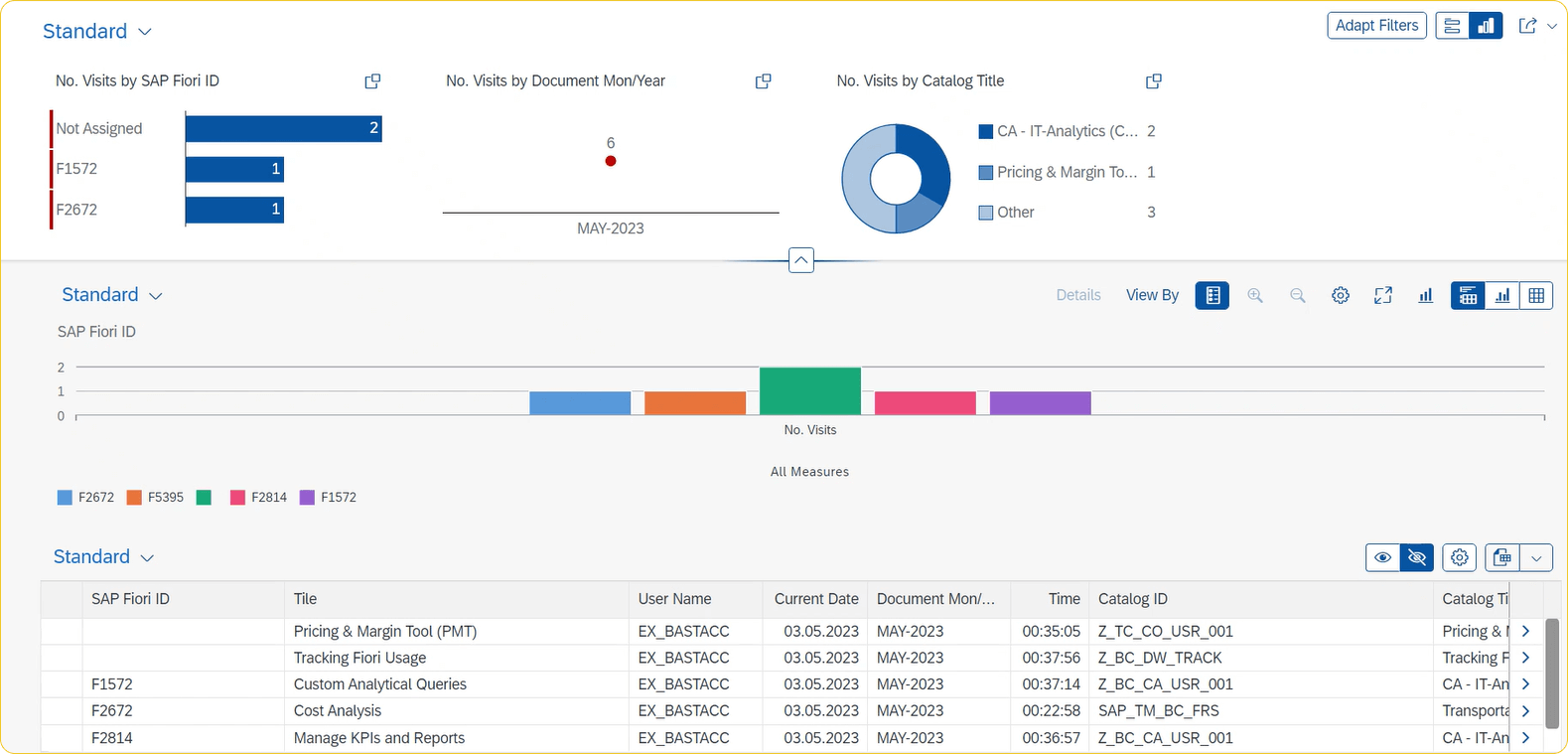
What is Fiori Usage Tracker?
Fiori Usage Tracker is a powerful tool designed to seamlessly integrate with your existing Fiori launchpad, allowing you to observe how users actually engage with this interface. Its extensive reporting capabilities empowers your organization to delve deeper into user behavior, patterns, and app popularity. Overall, Fiori Tracker provides a solution for organizations aiming to monitor and evaluate the utilization of Fiori applications within their R/3 and SAP S/4HANA systems, allowing them to analyze the significance and influence of these applications on their operational workflows.
Features of Fiori Usage Tracker
Every time a user starts the SAP Fiori application from the Fiori launchpad, Fiori Usage Tracker records the logs along with accurate time stamps, app title, user name, SAP Fiori id, and other associated attributes. Furthermore, the tool offers a diverse selection of charts, including bar charts, column charts, and donut charts, allowing you to visualize the data. The visual representations provided by the charts facilitate quick data interpretation, enabling users to identify trends, outliers, and patterns that may not be immediately apparent in raw data.
Benefits of Fiori Usage Tracker
- Provides the user access review
- Helps determine which applications should be prioritized, such as deciding the order in which change requests are developed
- Ease in identifying applications that are not being fully utilized within your system. This knowledge empowers you to take strategic actions, such as implementing process improvements and adjusting your system investments
- By identifying the applications that are receiving the most engagement, you can focus your efforts on further enhancing and expanding these successful solutions to attract more users
- Quickly and easily pinpoint the individuals who engage most frequently with your applications. Their feedback can provide invaluable insights into user preferences, pain points, and areas for enhancement
- Through user segmentation; gain insights into user behavior and preferences by categorizing users based on specific criteria, enabling targeted improvements and optimizations
- Tracking the last activity time of applications allows to monitor and optimize the usage, ensuring timely updates and improvements