Regularization-Based Methods
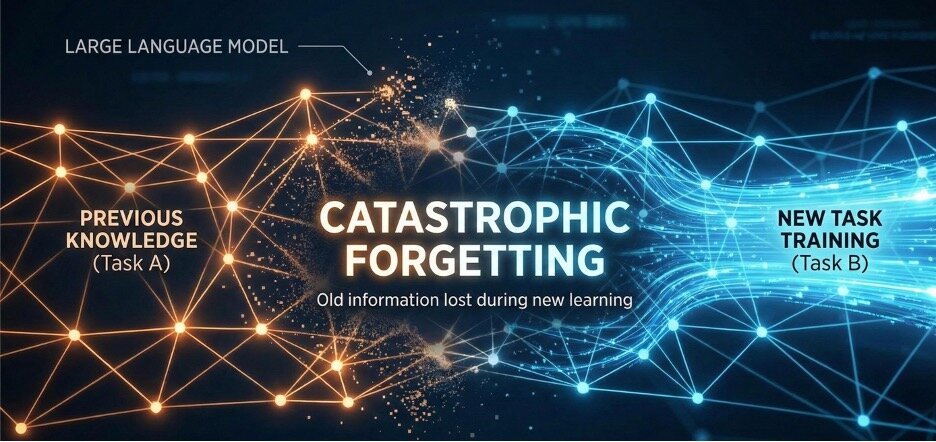
These approaches restrict how many “important” parameters are allowed to change during new learning. Elastic Weight Consolidation (EWC) estimates which parameters matter most for earlier tasks and adds a penalty when updates move those parameters too far, using a Fisher-information-based approximation. EWC’s quadratic penalty is an approximation and can introduce biases depending on task order and assumptions, so practitioners often compare it against replay or isolation baselines rather than treating it as a universal fix.
Rehearsal-Based Methods
Rehearsal methods reduce forgetting by mixing old examples with new training data. Experience Replay stores a small memory buffer of past examples (or compressed “exemplars”) and interleaves them during updates, helping gradients remain compatible with prior capabilities. More constrained variants, like Gradient Episodic Memory (GEM), explicitly project gradients so that learning new tasks does not increase loss on stored samples from previous tasks.
Architectural and Parameter Isolation Methods
Instead of updating the entire model, these strategies allocate new capacity or isolate trainable components. Progressive Networks avoid forgetting by freezing learned columns and adding new columns per task, with lateral connections enabling transfer. The trade-off is growth in parameters as tasks accumulate.
Parameter-Efficient Fine-Tuning (PEFT) adapts LLMs by training a small number of additional parameters while keeping the base weights frozen. A flagship method is LoRA, which injects trainable low-rank matrices into attention and feed-forward layers, achieving strong adaptation with far fewer trainable parameters than full fine-tuning.
Multi-timescale Learning and Consolidation
A recurring theme in both neuroscience-inspired and ML frameworks is separating fast adaptation from slow consolidation. The Complementary Learning Systems view motivates having a fast mechanism for rapid incorporation and a slower mechanism for stable long-term structure.
In ML, Progress and Compress operationalizes this idea with an
“active” component that learns quickly and a
“knowledge base” that consolidates via distillation after each task, aiming to preserve older skills without storing all past data. Related work on fast weights explores parameters that change shorter timescales than standard weights, supporting temporary memory without overwriting long-term knowledge.
Memory-Augmented Approaches
Sometimes the best way to “learn” new facts is not to rewrite the model at all.
Retrieval-Augmented Generation (RAG) treats the LLM as a reasoning and synthesis engine while storing updatable knowledge externally (vector databases, document stores, search indexes). The model retrieves relevant passages at inference time and conditions of generation on them, which can improve factuality and makes updates as simple as updating the corpus.
Importantly, RAG and continual learning are complementary: retrieval handles fast-changing facts; continual training handles durable skill acquisition, formatting, style alignment, and domain behaviors that retrieval alone cannot reliably encode.
What Are the Practical Challenges of Continual Learning in LLMs?
Continual learning sounds like the obvious next step, until you run into the three problems that decide whether it works in practice: proving you are improving, operating the update loop safely, and knowing when
not to update the model at all. Surveys on continual learning for LLMs repeatedly flag evaluation and safety as open challenges, for exactly these reasons.
Evaluation: Are you improving, or just overfitting the latest data?
If you only measure “new task accuracy,” you will ship regressions. A practical evaluation setup needs three scorecards:
- Retention scorecard (what you must not forget): a frozen regression suite covering core capabilities and high-risk behaviors. Track performance across updates to quantify drift.
- Acquisition scorecard (what you are trying to learn): time-sliced holdouts from the new data, plus “hard negatives” that distinguish memorization from generalization.
- Behavioral and safety scorecard: consistency checks for refusal behavior, instruction-following, and policy-sensitive outputs, since continual updates can shift model behavior in surprising ways.
If you cannot explain
why a change improved and
what it risks breaking, you are not ready to promote it.
Deployment and Operational Challenges in Continual LLM Systems
Continual Learning is an engineering discipline, not a training trick. Once you move from one-off fine-tunes to continual updates, you need an operational loop with guardrails: versioned data, reproducible training, automated regression tests, and fast rollback. The goal is explicitly to define boundaries and catch regressions, then govern how changes roll out.
This is why continual learning is best treated as an engineering discipline balancing stability and plasticity, plus privacy and audit constraints, rather than as a single algorithm.
When Not to Use Continual Learning
- Static domains: if the knowledge and task definition rarely change, you may be adding risk with little upside.
- Highly regulated or audit-heavy workflows: frequent behavior changes can be hard to justify, reproduce, and certify. Privacy, retention, and auditability become first-order constraints.
- When your real need is “fresh facts,” not new skills: prefer external memory and retrieval. Updating the knowledge base can be auditable and reversible, without rewriting model weights.
Use retrieval for fast-changing facts, use controlled continual updates for durable skill acquisition and behavior shifts and avoid continual learning where governance requirements make frequent behavioral drift unacceptable.
Real-World Applications of Continual Learning in LLMs
- Real-time business intelligence: keeping product specs, policies, and internal procedures current via retrieval plus lightweight updates where behavior shifts are needed.
- Domain evolution: continual pretraining across sequences of domain corpora can improve in-domain performance while managing forgetting, especially when domains arrive over time.
- Personalized assistants: adapting tone, workflows, and preferred outputs, ideally with explicit user controls and retention policies to avoid unsafe drifts.
- Knowledge base maintenance: ingestion, validation, and provenance tracking in external memory, so updates are auditable and reversible.
How to Build Adaptive LLM Systems with Continual Learning
Continual learning is less a single algorithm than an engineering discipline: balancing stability versus plasticity, managing data and privacy constraints, and selecting the right update mechanism for the type of change you expect. Catastrophic forgetting is real and well documented, but so is the growing toolbox for mitigating it, from regularization and replay to PEFT and retrieval-based memory.
For technical teams, the practical endgame is not a model that retrains endlessly, but an adaptive system with clear boundaries: what should be retrieved, what should be updated, how regressions are detected, and how changes are governed. For business leaders, the takeaway is straightforward: static models become stale; adaptive pipelines compound in value.
References & Further Reading
[1] McCloskey, M., & Cohen, N. J. (1989). Catastrophic interference in connectionist networks: The sequential learning problem.
[2] Kirkpatrick, J. et al. (2017). Overcoming catastrophic forgetting in neural networks (EWC).
[3] Rolnick, D. et al. (2019). Experience Replay for Continual Learning.
[4] Lopez-Paz, D., & Ranzato, M. (2017). Gradient Episodic Memory for Continual Learning (GEM).
[5] Hu, E. J. et al. (2021). LoRA: Low-Rank Adaptation of Large Language Models.
[6] Ding, N. et al. (2023). Parameter-efficient fine-tuning of large-scale pre-trained language models.
[7] Ke, Z. et al. (2023). Continual Pre-training of Language Models.
[8] Wu, T. et al. (2024). Continual Learning for Large Language Models: A Survey.
[9] Biesialska, M. et al. (2020). Continual Lifelong Learning in Natural Language Processing: A Survey.