



SAP Flexible Workflow is a workflow model that lets business process specialists configure condition-based approval workflows for sourcing, procurement and finance documents through predefined SAP Fiori apps, without needing a developer or a workflow builder. It sends notifications to approvers through Fiori and email so they can approve, reject, or send documents for processing.
Flexible Workflow expands SAP Business Workflow, enhancing its accessibility, reach and flexibility to suit growing cloud-based innovation needs. This guide explains what SAP Flexible Workflow is, its scenario types, how it compares to classical workflows, and the steps to configure it.
SAP Flexible Workflow is a general function that aims to simplify workflow configurations. It lets you create a condition-based flexible workflow for sourcing and procurement approval processes. Teams also use it to approve procurement documents such as purchase requisitions, purchase orders, requests for quotations, or supplier invoices in Sourcing and Procurement.
For example, in a typical approval process for a purchase order: any PO over €2,000 requires manager approval, and any PO over €6,000 requires two levels of approval.
Flexible workflow enables business process specialists to build workflows using predefined workflow scenarios and tasks. This means flexible workflows stick to the same principles as classical workflows but development teams can build them with the SAP Fiori application, without development tools.
Flexible workflows are based on predefined application objects such as activities, workflow scenarios, and step and start conditions. With the Manage Workflows application, your business process professionals can model workflows according to business needs through predefined objects and integrated functions.
Teams customize flexible workflows through scenarios that they create and adapt to their process needs without development work. Key users can also change and edit these scenarios themselves, without needing developers. Teams can configure process flows, assign recipients, or set initial conditions. Custom workflows are defined through the Fiori app, and the approval action also takes place in the same environment. Flexible workflow supports many options for determining approvers and lets you specify when a workflow step should trigger based on a condition. You can define one-step or multi-step approval processes depending on your requirements. Compared to classical workflows, flexible workflows carry lower costs.
Flexible workflows fall into two categories: standard flexible scenarios and custom (special) flexible scenarios.
To meet approval flows, SAP offers many classic workflow templates for processes such as purchase request approval and invoice approval. SAP offers similar flexible workflow templates for standard approval flows in SAP S/4HANA and has created help documents for the correct implementation of these templates. Standard flexible scenarios are a non-coded or low-coded option for the SAP S/4HANA system. Business process professionals can quickly configure and go live with these standard scenarios when they need an approval flow for standard transactions.
Standard templates sometimes cannot fulfil every scenario. In such cases, SAP offers the flexibility to create custom scenarios where the requesting party fills in data and sends it for approval. The approving party checks and approves the data, and after approval, the data transfers to SAP. These transactions do not have a standard template because they answer a special need. Teams create the workflow templates in SAP Fiori with the Manage Workflows application.
The table below summarizes the main differences.
Aspect | Classical Workflow | Flexible Workflow |
Setup | Requires SAP Business Workflow builder and technical knowledge | Configured through predefined objects, mostly no-code or low-code |
Structure | One large, often complex workflow | Reusable scenarios combined into versatile, shorter workflows |
Trigger | Fixed process logic | Condition-based; a step only fires when its precondition is met |
Who can change it | Requires a developer | Key users can adjust scenarios without a developer |
Typical cost | Higher, due to development effort | Lower, due to configuration-based setup |
Classical workflows are the classic workflows SAP offers, created using a workflow builder; they are also known as simple workflows or workflow templates. A classic workflow requires technical knowledge of SAP Business Workflow and is less flexible when you need to change workflow processes.
Flexible workflows are reusable templates that build versatile, customized workflows in different sequences instead of one single, complex workflow. Triggering depends on a condition being met, which makes structuring business process flows easier. Teams configure the conditions and process flow for the resulting workflows through the Fiori Manage Workflow application.
Flexible workflow supports one-step or multi-step approval processes; depending on requirements, teams can assign one or more approvers to each step for purchase requisitions. Approvers of the defined approval process can be assigned by role, or assigned to teams as well as individuals depending on the system's needs. Using the My Inbox app, approvers can approve or reject the process work items. SAP approves purchase orders automatically if no workflow is defined for the process, so flexible workflow is what gives you control over the approval process. Approvers get notified through the SAP Fiori launchpad or by email about new work items, and purchasers get informed by email whether SAP approved or rejected their purchase order.
For more detailed information about flexible workflow, you can contact our SAP Fiori consultants by filling out the form on our "Contact" page.
Along with the configuration, you can optionally transport the workflow from quality to production, troubleshoot workflow errors and issues, and update the recipients.

With this app for finance, you can build workflows for your business needs and activate them. In this app, you define preconditions to start a workflow for journal entries and currency adjustments. For verification, you can create, edit and activate workflows, and you can also define the step sequence and exception handling, such as when a workflow ends.
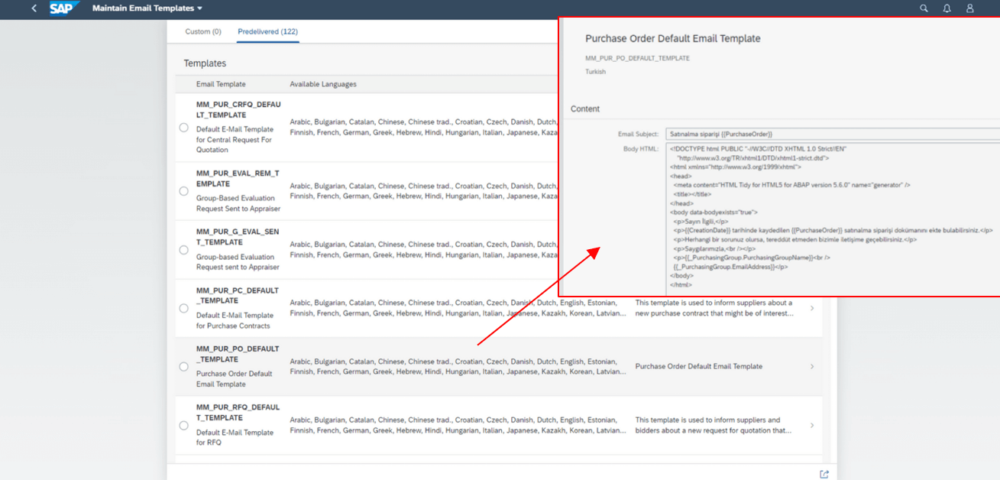
The Maintain Email Templates app lets you define email templates so you can arrange custom emails tied to your flexible workflow, without needing any development. Users also get notified about work items via email along with Fiori launchpad notifications. You create custom templates through this tool, where you define subject and body text and create language-specific variants. To write the content of the email dynamically, you use parameters; since the tool fully supports HTML, users can view the request in their inbox directly and dynamically through the hyperlink in the email.
SAP Business Workflow (classical workflow) needs a workflow builder and technical knowledge to change. Flexible workflow uses predefined scenarios that key users configure and adjust through Fiori apps, without a developer.
Yes. Key users can create, adjust and activate flexible workflow scenarios through the Manage Workflows Fiori app, including preconditions, approvers and process flow.
SAP approves the purchase order automatically when no workflow is defined for that process. Flexible workflow is what gives you control over the approval step.
Yes. You can define one-step or multi-step approval processes and assign one or more approvers to each step, depending on your requirements.
SAP Flexible Workflow lets you build condition-based, configurable approval workflows for procurement and finance documents through SAP Fiori, without a developer for most standard scenarios. Check whether a standard scenario fits your process before building a custom one. For support with your flexible workflow configuration, contact MDP Group.

SAP Fiori Consultant
Özge Yılgür is an SAP consultant at MDP Group specialized in SAP Fiori and SAPUI5. She develops custom UI5 applications on S/4HANA using OData and CDS services. She delivers Clean Core–compliant solutions and designs cloud architectures with SAP BTP, Fiori Elements, and CAP. She assumes end-to-end responsibility in international projects.
Your mail has been sent successfully. You will be contacted as soon as possible.
Your message could not be delivered! Please try again later.