


During the transition from the on-premise environment to the cloud, core capabilities that enable cloud-based use of ATC to ensure centralized ABAP test cockpit (ATC) quality control were introduced. These capabilities include key features that include configuration with the ATC Configurator application and management of custom ATC check variables.
With SAP BTP, ABAP environment 2311 (November 2023 release), the remote developer scenario between ATC in the cloud and developers on on-premise systems is also enabled.
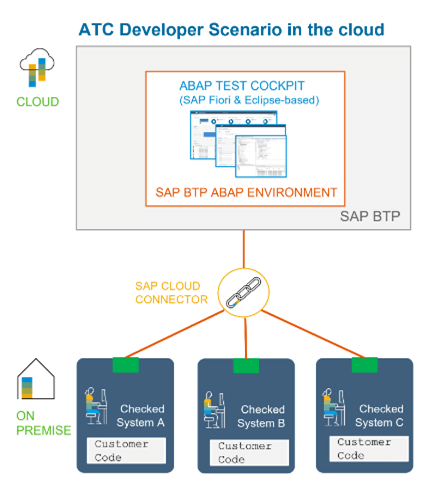
ABAP developers on the on-premise SAP system can now control their code during the development process and request exceptions when necessary, using ATC checks from the central ATC check system provided by SAP BTP.
You can log in to the ABAP environment by accessing SAP BTP, and RFC and SAP Cloud Connector are used to communicate with on-premise systems in the ABAP environment. You need to create a communication arrangement based on the Custom Code Passing Integration (SAP_COM_0464) communication scenario.
To enable developers on on-premise systems to check their code using the remote ATC check variant of the centralized ATC check system in the cloud, a communication arrangement based on the ABAP Test Cockpit – Reference Check System Inbound Integration communication scenario needs to be created.
For this, it is necessary to log in to the SAP Fiori launch panel in the SAP BTP, ABAP environment. In the Communication Management section, the Communication Arrangement box is selected and a new communication arrangement is created using the SAP_COM_0936 scenario. Communication System and Object Provider are entered. The Communication System must be previously defined as Inbound Only under the Communication System box. The Object Provider is specified in the communication arrangement for the integration of your on-premise system based on communication scenario SAP_COM_0464.
To configure the developer scenario in an on-premise checked system (in the ATC operation under basic settings), the connection to the central ATC check system in the cloud and the corresponding reference must be entered in the ATC check variant.
To do this, the RFC target to the centralized ATC check system in the cloud must be pre-created in transaction SM59.
On an on-premise system, simply run ATC on the code using the default system check variant in the ABAP development tools for Eclipse. (Context menu, choose Run As > ABAP Test Cockpit).
Thanks to the central ATC check system in the cloud, you can also perform remote ATC checks for your transportation requests before they are issued.

When using a centralized ATC check system in the cloud, you can also apply quick fixes in ABAP development tools for Eclipse to your source code in the on-premise system. (Quick fixes are supported in SAP S/4HANA 1809 and later).

SAP ABAP Consultant
Your mail has been sent successfully. You will be contacted as soon as possible.
Your message could not be delivered! Please try again later.