2.3 The Hybrid Memory Architecture
In production-grade applications, relying on a single memory type is rarely enough. To build a truly intelligent assistant that feels "human," developers often combine these techniques into a Hybrid Architecture.
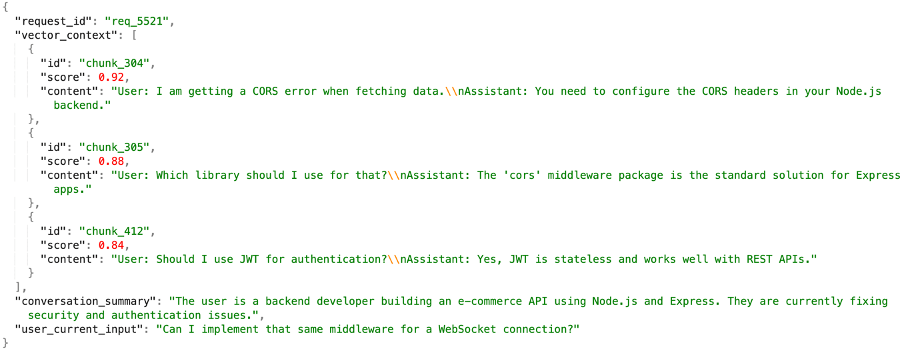
This approach leverages the strengths of all three methods simultaneously to create the perfect context for the Large Language Model (LLM):
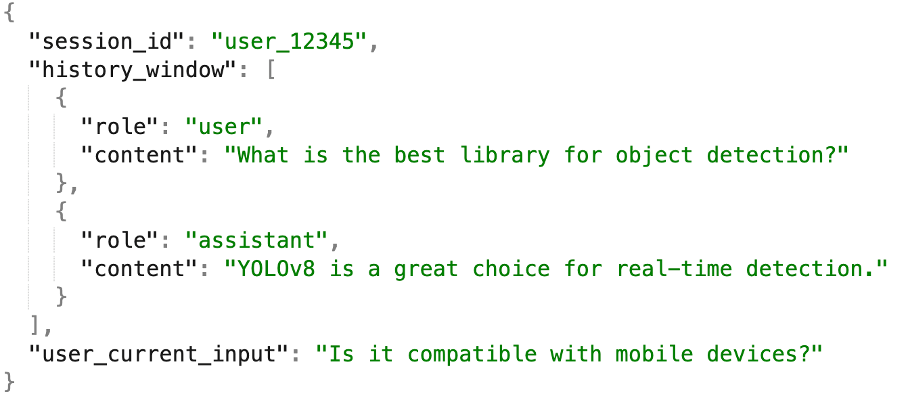
- Sliding Window (The "Now"): It keeps the last few messages (e.g., 3-5 turns) in the prompt to ensure the immediate conversation flows naturally. This allows the bot to understand pronouns like "it" or "that" referring to the previous sentence.
- Vector Store / RAG (The "Detail"): It acts as the long-term archive. Instead of waiting for a direct question, it proactively retrieves relevant past interactions to support and enrich the current dialogue, ensuring the new conversation is always grounded in the user's historical context.
- Conversation Summary (The "Context"): It maintains the "big picture." Even if specific details slide out of the window, the summary preserves the user's overall goals and key information, ensuring critical facts are never lost during long interactions.
Pros:
It provides the most natural and high-quality user experience possible. The chatbot understands immediate references, recalls past details, and maintains the overall context, making the interaction feel truly intelligent and "human-like."
Cons:
It significantly increases token usage (cost) since the prompt is packed with multiple layers of context. It also introduces higher latency, as the system must perform vector retrieval and summarization updates in real-time before generating a response.
3.Conclusion
Ultimately, there is no "one-size-fits-all" solution for chatbot memory. The right technique depends entirely on the purpose of your bot and the nature of your user interaction.
If you have a high-traffic chatbot with transient users, such as a product promotion bot on an e-commerce website, you do not need complex infrastructure. Since users are likely asking quick questions, prioritizing cost efficiency and speed is key. In such scenarios, simple Short-Term Memory is more than sufficient to provide a smooth experience without breaking the budget.
On the other hand, if you are building a Personal AI Tutor or a Financial Advisor, the context changes. The bot needs to rely on Summary Memory to keep track of the student's overall strengths and areas for improvement. At the same time, it uses Vector Memory to recall that they specifically struggled with "Calculus" last month, while Short-Term Memory helps them solve the equation they pasted ten seconds ago. For these deeply personalized experiences, a Hybrid Architecture is essential.
At
MDP Group, we understand that every project has unique requirements. We carefully evaluate the specific nature of the
AI agent, whether it demands deep personalization or high-volume efficiency, and implement the most suitable memory solution to build the most effective and optimized results.