


In EWM Monitor we can display volume by different units of measure. In this blog, I will explain how you can calculate desi as a volume unit in material master and display it accordingly in the EWM Monitor. Below, you may see relevant configurations and test steps on S4HANA. We will be testing desi calculation with 2 test cases:
Test Case 1: Display Desi in Material Master
Test Case 2: Display Desi in Monitor
(TCODE: CUNI)
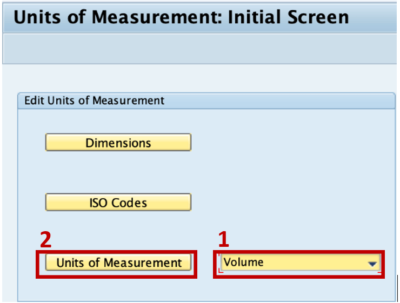
Go to transaction code CUNI and select box number 1 as Volume and go to Units of Measurement. You will display all volume measurements that are defined in the system, what we are looking for here is cubic centimeters (CCM).
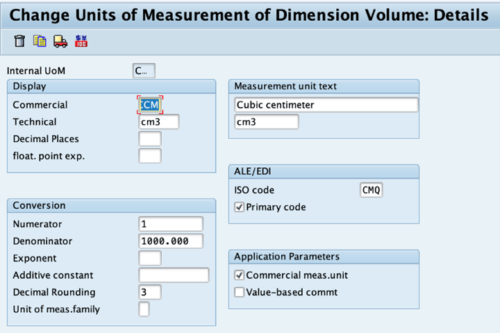
In order to calculate ‘desi’ of a material, the equation is as follows:
(Length*width*height)/3000
In this section, we chose CCM because cubic centimeter is calculated by multiplying the length, width, and height of a product. We want to use this equation and eventually, we need to divide this by 3000.
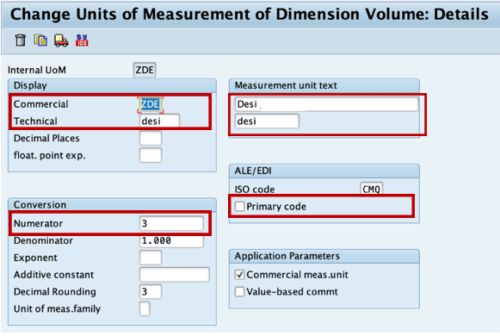
I named the new measurement Unit as ZDE. At this point, changing the numerator is crucial as it will correctly calculate the desi equation. ((L*W*H)/3000)
(IMG: Extended Warehouse Management > Master Data > Define Warehouse Number Control)
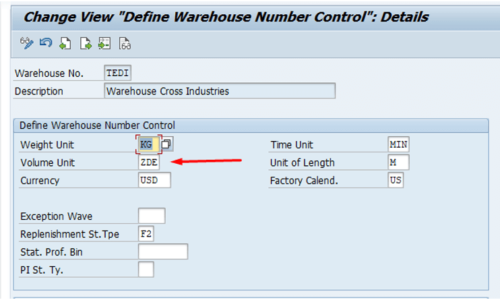
There is an additional configuration you need to complete so that you can display volume in ZDE Unit in the warehouse monitor. In warehouse number control, you need to update the volume unit as ZDE, so that the system uses ZDE as the default unit of measure for volume.
Thus, we have successfully created a new measurement to calculate volume as desi for any product. In the next part, we will be testing our configurations on an example product. (ZEWM_TEDI1 in my case)
(MM02 > Basic Data 1 > Additional Data > Unit of Measure)
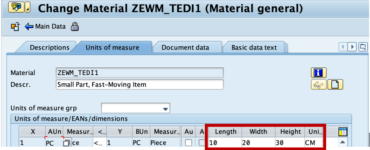
For the relevant material, I entered dimensions in CM form as shown above. The system will use this information to calculate volume in ZDE*.
*Expected outcome would be: (10x20x30)/3000=2
(MM02 > Basic Data 1 > Additional Data > Unit of Measure)
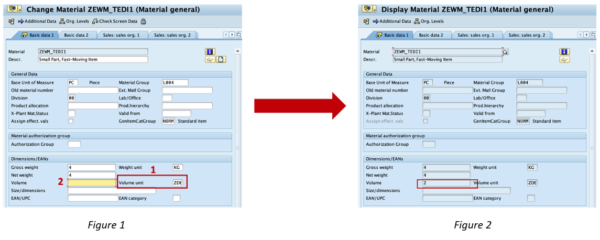
In Figure 1 you should update volume unit as ZDE in box number 1 and leave box number 2 empty. Then save material. Thus, the system will calculate volume in ZDE automatically and you can display it if you go to Basic Data 1 again as shown in Figure 2.
If Figure 2 shows the expected outcome, it means your configuration is correct and you can use ZDE for any product that you want to handle in desi.
(/SCWM/PRDI)
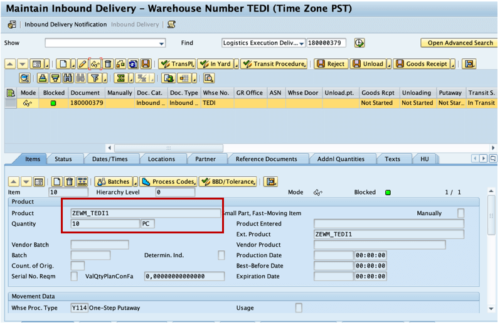
We created a purchase order and inbound delivery for relevant material in 10 PCs* for this case as shown above.
* Expected volume in monitor would be: 20 ZDE
(/SCWM/PRDI)
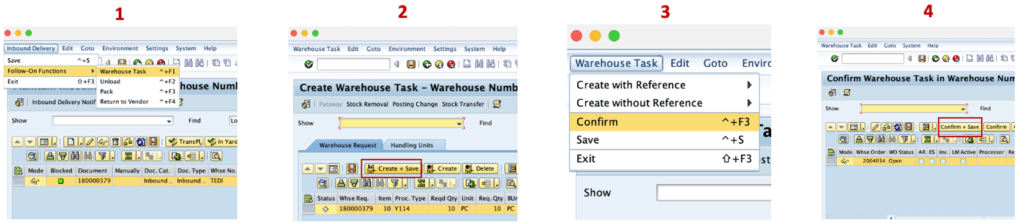
For inbound delivery of 10 PCs, we create and confirm warehouse task. We need to be able to display material in the EWM Monitor.
(/SCWM/MON)
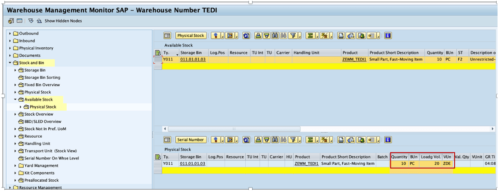
Go to the warehouse monitor and display available stock for relevant material. If your configuration is correct, you need to be able to display volume unit in ZDE and the expected amount. In this case, it was 20 ZDE and it can be displayed correctly as seen above.
Materials can be managed through different volume units; SAP has many standard measurements and you can also create a new unit for your process’ needs. The calculation of desi was completed by using cubic centimeters and additional configurations.

SAP EWM/TM Consultant
As a consultant specializing in SAP logistics modules, I provide end-to-end solutions in warehouse operations, shipment planning, and freight cost management processes. I actively participate in system design and integration projects that increase operational efficiency and optimize costs, primarily focusing on SAP EWM and TM.
Your mail has been sent successfully. You will be contacted as soon as possible.
Your message could not be delivered! Please try again later.