



Time series forecasting has been dominated by increasingly complex architectures. From CNNs to RNNs, from Transformers to MLP-mixers, we've thrown everything at the problem of predicting the future from past data. Yet a fundamental question remains: Why are we forcing models to memorize patterns when we could simply look them up?
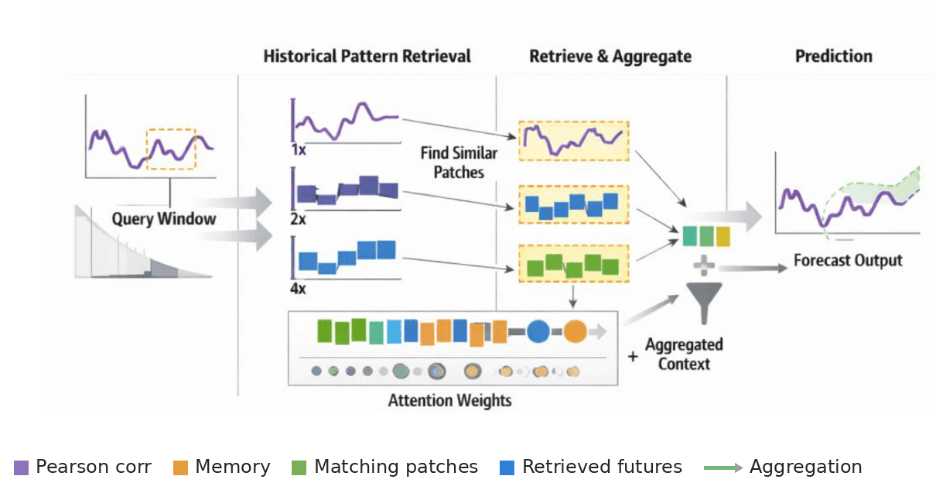
See RAFT (Retrieval-Augmented Forecasting of Time-series), a refreshingly simple yet powerful approach from researchers at KAIST, Max Planck Institute, and Google Cloud AI. Instead of relying solely on learned parameters, RAFT retrieves relevant historical patterns from the training data at inference time, and the results are striking.
Retrieval-Augmented Time Series Forecasting is an approach that improves prediction models by retrieving similar historical patterns at inference time rather than relying only on learned model parameters. Instead of forcing a neural network to memorize rare or unstable patterns within its weights, the system dynamically searches past data for comparable sequences and uses their subsequent values to guide future predictions. This retrieval mechanism acts as an external memory layer, helping the model respond more effectively to uncommon events or weak temporal correlations.
RAFT reframes time series forecasting by shifting the burden from memorization to retrieval. Rather than forcing models to internalize rare, unstable, or weakly correlated patterns within fixed parameters, it retrieves similar historical sequences at inference time and uses them to guide predictions. This simple yet powerful design improves performance across benchmarks, particularly in scenarios where traditional deep learning struggles. The key insight is clear: smarter access to historical data can outperform increasingly complex architectures.
Dataset | RAFT | Best Baseline | Improvement |
ETTh1 | 0.420 | 0.447 (TimeMixer) | 6.0% |
ETTh2 | 0.359 | 0.364 (TimeMixer) | 1.4% |
ETTm1 | 0.348 | 0.381 (TimeMixer) | 8.7% |
ETTm2 | 0.254 | 0.275 (TimeMixer) | 7.6% |
Electricity | 0.160 | 0.182 (TimeMixer) | 12.1% |
Exchange | 0.441 | 0.386 (TimeMixer) | -14.3% |
Illness | 2.097 | 1.480 (PatchTST) | -41.7% |
Solar | 0.231 | 0.216 (TimeMixer) | -7.0% |
Traffic | 0.434 | 0.484 (TimeMixer) | 10.3% |
Weather | 0.241 | 0.240 (TimeMixer) | -0.4% |
Pattern Occurrences | RAFT (no retrieval) | RAFT (with retrieval) | Improvement |
1 (rarest) | 0.2590 | 0.2209 | 14.7% ↓ |
2 | 0.2310 | 0.2064 | 10.7% ↓ |
4 | 0.2344 | 0.2128 | 9.2% ↓ |
Pattern Occurrences | Improvement with Retrieval |
1 | 31.5% MSE reduction |
2 | 31.4% MSE reduction |
4 | 16.0% MSE reduction |
Dataset | AutoFormer | AutoFormer + Retrieval |
ETTh1 | 0.496 | 0.471 |
ETTm2 | 0.450 | 0.444 |
ETTh1 | 0.588 | 0.454 |
ETTm2 | 0.327 | 0.326 |

Data Scientist
Data Scientist architecting scalable ML systems. Builds production-grade solutions that combine predictive analytics with agentic AI capabilities.
Your mail has been sent successfully. You will be contacted as soon as possible.
Your message could not be delivered! Please try again later.