

In today's rapidly evolving business landscape, organizations seek to leverage data-driven insights to optimize their operations, as implementing a project requires significant investments in time, effort, and resources. One key aspect in evaluating the success of these initiatives lies in the ability to effectively track and understand the usage of programs. With SAP Fiori becoming the go-to user interface for SAP applications, tracking and analyzing Fiori app usage data has gained importance.
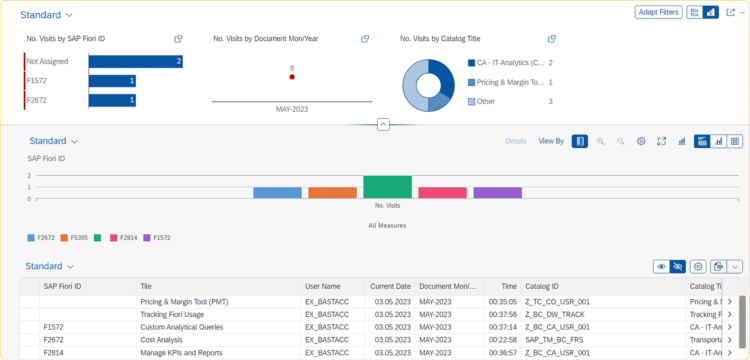
Fiori Usage Tracker is a powerful tool designed to seamlessly integrate with your existing Fiori launchpad, allowing you to observe how users actually engage with this interface. Its extensive reporting capabilities empowers your organization to delve deeper into user behavior, patterns, and app popularity. Overall, Fiori Tracker provides a solution for organizations aiming to monitor and evaluate the utilization of Fiori applications within their R/3 and SAP S/4HANA systems, allowing them to analyze the significance and influence of these applications on their operational workflows.
Every time a user starts the SAP Fiori application from the Fiori launchpad, Fiori Usage Tracker records the logs along with accurate time stamps, app title, user name, SAP Fiori id, and other associated attributes. Furthermore, the tool offers a diverse selection of charts, including bar charts, column charts, and donut charts, allowing you to visualize the data. The visual representations provided by the charts facilitate quick data interpretation, enabling users to identify trends, outliers, and patterns that may not be immediately apparent in raw data.

SAP Fiori Consultant
Selin Köleş is an SAP consultant specialized in SAP Fiori and ABAP development. At MDP Group, she focuses on SAPUI5, ABAP Cloud, RAP, Fiori Elements, SAP BTP, the SAP Clean Core strategy, and SAP AI Core. She actively participates in Fiori application development projects within the SD, MM, FI, and EWM modules.
Your mail has been sent successfully. You will be contacted as soon as possible.
Your message could not be delivered! Please try again later.