

SAP QM and EWM integration connects SAP Quality Management with SAP Extended Warehouse Management through the Quality Inspection Engine (QIE), so that quality inspections are triggered automatically during warehouse processes such as goods receipt, returns, and internal storage. This ensures that only quality-approved stock moves through the warehouse.
SAP Quality Management (QM) is a part of SAP ECC (ERP Central Component) which is mainly used to help businesses maintain their quality standards. It is aiming at making quality control processes monitored in an efficient and sustainable way.
To integrate the QM function to SAP Extended Warehouse Management (EWM), the quality inspection engine (QIE) is used. The QIE, in general, executes inspection processes that are triggered by EWM. It is possible to use QIE alone, or integrated with QM in SAP ERP.
According to the inspection object type (IOT) and inspection rule in master data, inspection documents are created. Then, samples, findings and decisions are established using business data. Eventually, follow-up action is triggered.
IOT includes the software component, the business process for the inspection, inspected object, such as the product, and the warehouse number. Taking into account the properties (selection criteria), the inspection rule decides the object to be inspected and designates other details, such as procedure and frequency. There can be multiple inspection rules for a single IOT. When the system looks for an inspection rule and finds one, it generates an inspection document based on the inspection object type.
There can be many items and samples in an inspection document, and multiple findings attached to them. However, there can be only one decision. It is possible to have a follow-up action assigned to a decision.
When an inbound delivery notification is activated, SAP EWM automatically produces an inspection document to check the completeness of the delivery and releases it. The document is reserved as a reference document for the delivery header in the inbound delivery, and cannot include samples or items.
Counting is a procedure used in goods receipt to analyze whether the expected quantity and the actual quantity matches. The system generates the inspection document and releases it automatically, according to the settings that are already defined as either when the inbound delivery status is set to “In Yard” or at the activation of the inbound delivery. Counting can be executed explicitly at a special work center for counting, or implicitly during warehouse task confirmation. The counting result can be saved in the inspection document.
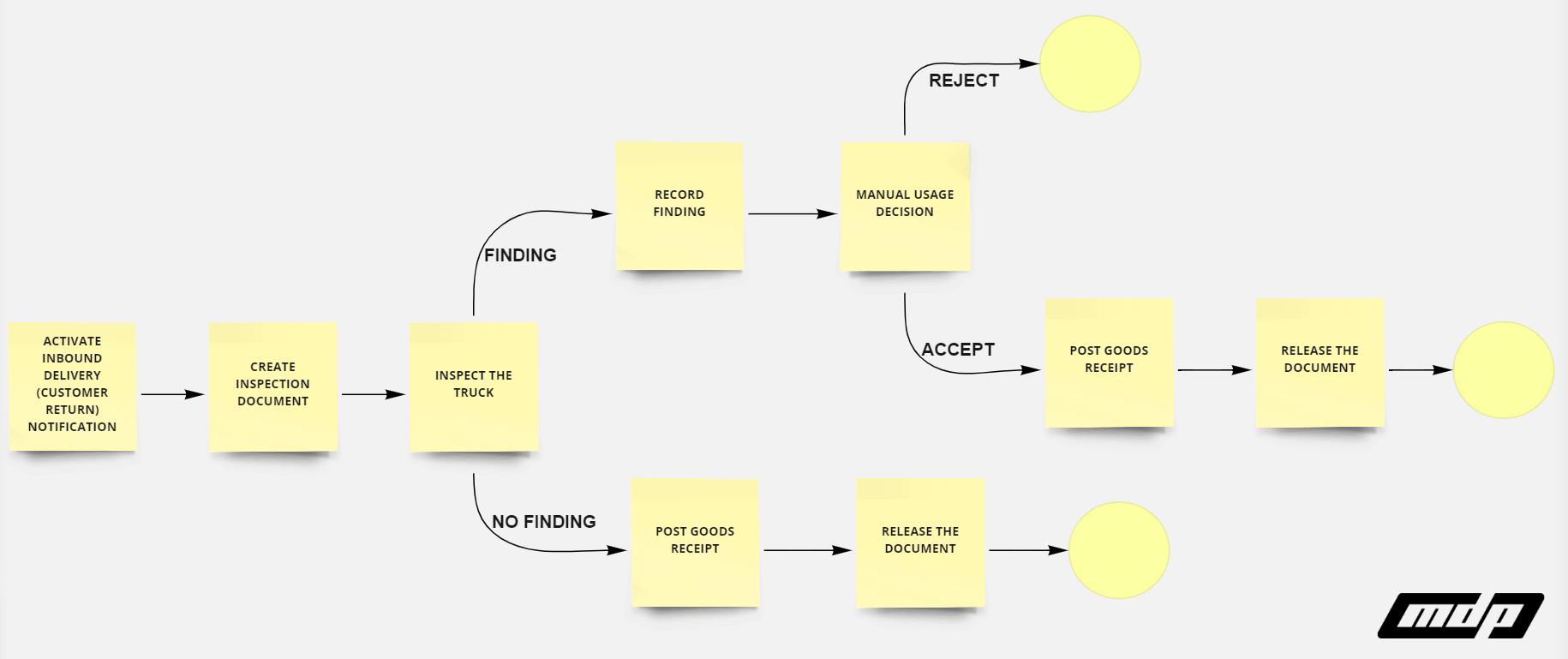
It is used to deal with inspections of customer returns. Delivery quantity forms the basis of the inspection quantity. The system releases the inspection document upon posting of the first goods receipt, and forwards it to an external system if needed.
When it comes to individual products or batches during inbound delivery, IOT 4 is used. The system generates the inspection document automatically, based on the settings that are already configured as either when the inbound delivery status is set to “In Yard” or at the activation of the inbound delivery. The document is released with the first goods receipt. There are multiple inspection processes, such as inspection after goods receipt, quality inspection before goods receipt posting for externally procured goods, acceptance sampling, and pre-sampling in production. Quantity to inspect is derived from delivery quantity and inspection rule of sample size.
To inspect goods that are already in the warehouse, IOT 5 is used. Inspections can be executed periodically or shortly before the shelf life expiration date. warehouse-internal product inspections have to be created manually by means of radiofrequency, warehouse monitor, or desktop transaction.
It is used to inspect HUs before goods receipt posting. For each delivery of a complete TU, all HUs are categorized as “good” or “incorrect”. After the classification of all the HUs are done, the system automatically generates an inspection document. It is not possible to schedule inspection documents in advance. The system generates a single inspection document for each delivery and a single item for each HU.
Integrating SAP QM with SAP EWM ensures that quality control is embedded directly into warehouse operations rather than handled as a separate, manual step. When inspections are triggered automatically at goods receipt, returns, or during storage, businesses prevent defective or non-conforming stock from being put away or shipped. This improves inventory accuracy, supports regulatory compliance, reduces manual effort, and gives a single, auditable record of quality decisions across the warehouse. For a broader look at the warehouse system itself, see our guide on SAP Extended Warehouse Management (EWM).
What is the Quality Inspection Engine (QIE) in SAP EWM?
The Quality Inspection Engine (QIE) is the component that executes inspection processes triggered by SAP EWM. It can be used on its own or integrated with SAP QM in SAP ERP, creating inspection documents based on the inspection object type and inspection rules.
What are inspection object types (IOTs) in SAP EWM?
Inspection object types define which warehouse scenario triggers a quality inspection. SAP EWM supports six IOTs, covering preliminary inbound inspection, counting, returns, product or batch inspection at inbound, warehouse-internal inspection, and handling unit inspection.
Can QIE be used without SAP QM?
Yes. The Quality Inspection Engine can run standalone within SAP EWM, or it can be integrated with SAP QM in SAP ERP when full quality management functionality, such as detailed inspection planning and results recording, is required.
SAP Extended Warehouse Management - SAP Help Portal
What is SAP Extended Warehouse Management (EWM)?
SAP EWM Consultancy

SAP EWM Consultant
Your mail has been sent successfully. You will be contacted as soon as possible.
Your message could not be delivered! Please try again later.