

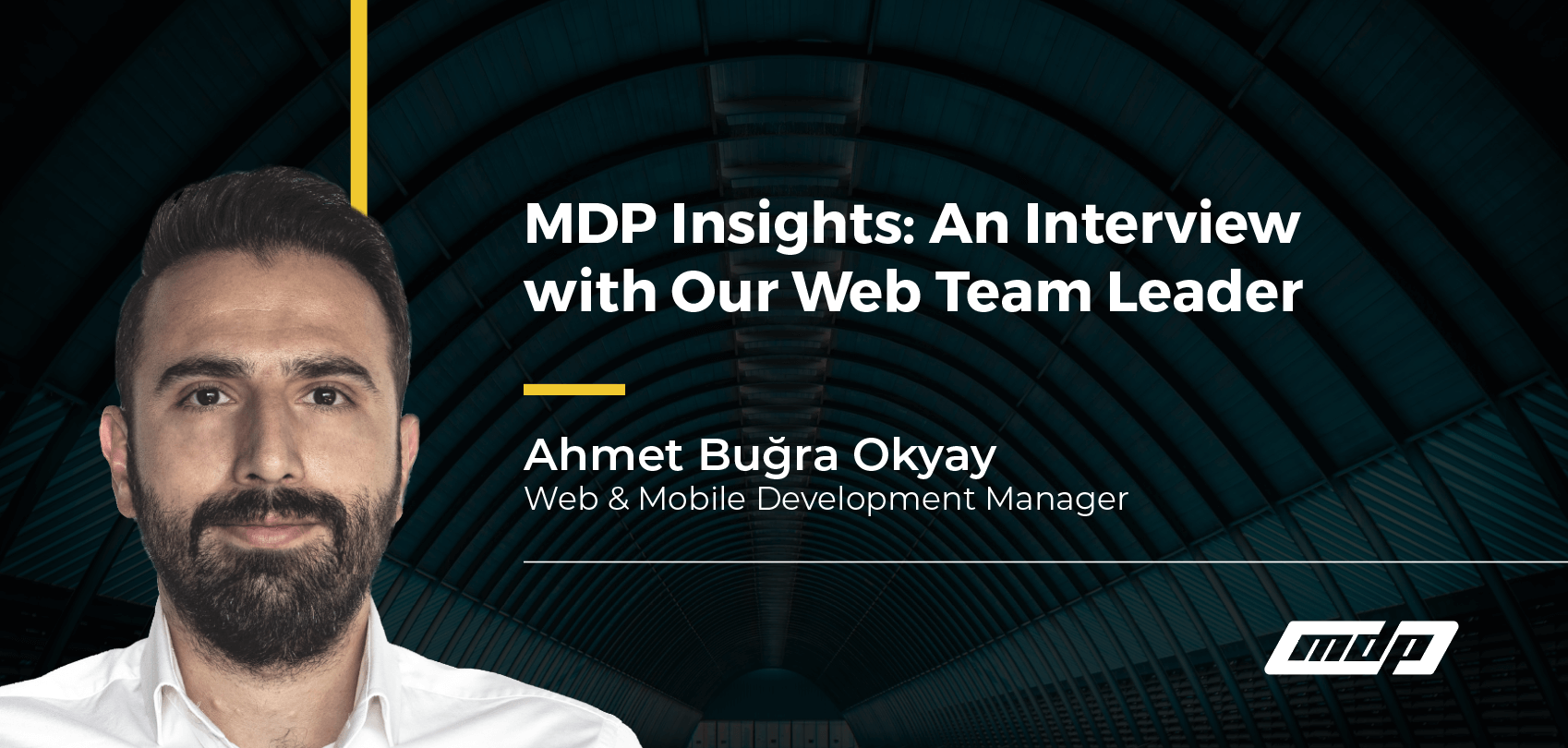
MDP Group's web and mobile development team specializes in building tailor-made digital solutions that bridge SAP systems with modern web and mobile technologies. Founded in 2016, the team combines deep SAP expertise with cutting-edge frontend and backend development, delivering custom products that fit each client's unique workflows. In this MDP Insights interview, we sat down with Ahmet Buğra Okyay, Web & Mobile Development Manager, to explore how the team operates, what technologies they use, and how they think about building great software.
MDP Group's Web & Mobile Applications Department was formed in 2016 and — true to their name — develops web and mobile applications. They're also in charge of R&D and have completed some vastly interesting projects over the years. The team operates at the intersection of enterprise SAP systems and modern software development, making them a unique asset within the MDP organization.
Tell us a little about your team and what you do...
Our focus at MDP has always been the client. This, of course, applies to the Web team as well. The client is the basis for the innovation we achieve here. Our motivation is ensuring that we address and exceed our clients’ expectations. Whether this is solving a problem or developing something specific, we go all in.
We describe the work we do as "tailor-made products." Although I have nothing against out-of-the-box solutions, that's not what we do here. Much like a tailor, we take our clients’ measurements (figuratively speaking), assess the style and function that would best suit them, and produce a custom product that fits like a glove. Our clients are always pleased when they see that we incorporated some aspect of their corporate identity into a project.
"We describe the work we do as 'tailor-made products.'"
Are these services exclusive for clients that work with SAP?
Although we're widely known as an SAP consultancy firm, we have clients that work with SAP and non-SAP alike. Our web and mobile capabilities serve both segments equally well, and we often find that clients benefit from our dual expertise — deep SAP knowledge combined with modern development practices. This dual capability means a single trusted partner can handle both ERP complexity and digital product development end-to-end.
How do you come up with ideas for projects?
We fuse widely accepted libraries and frameworks that have proven successful with the capabilities of SAP technology. We refer to best practices for guidance but create unique products. We work in compliance with globally accepted UI/UX standards. The evolution from SAP GUI to SAP Fiori has significantly shaped how we think about user experience in SAP-connected products. For deeper reading on Fiori design principles, our guide on SAP Fiori UI/UX and Design Thinking covers the methodology our team applies in enterprise application projects.
What languages and frameworks do you use?
We have excellent talent in Javascript and ABAP. We started working with jQuery, which progressed into AngularJs and lastly React, React Native, and Flutter. We choose the language based on what works best for the project.
Typically, for web applications that run on SAP, we use ReactJs, OpenUI5 (Fiori), ABAP, Go, and NodeJS. For mobile applications on SAP: React-Native (Javascript) and Flutter (Dart). If needed, we work with Swift and Java/Kotlin for native mobile applications.
For applications that don't run on SAP or work indirectly integrated with SAP: ReactJs for frontend; React-Native and Flutter for mobile; Swift and Java/Kotlin when needed; NodeJs, Go, PHP, and Python for backends. The database varies — MongoDB, PostgreSQL, MySQL, or MSSQL depending on the project.
How do these applications work with SAP?
Our web-based products run on SAP through SAP's BSP technology, eliminating the need for extra servers. These Javascript web applications work with RESTful services, which is the basis for modern web design. We develop these services through BSP or by using OData and ABAP.
If a customer has ABAP resources, they can further develop our product without our assistance. Many of our clients feel reassured that we give them the source code to their projects. Our mobile applications work similarly — after compiling, the app runs directly on mobile devices. Clients can publish on app stores, or we share IPA or APK files for private distribution.
"Many of our clients feel reassured that we give them the source code to their projects."
What about non-SAP products?
This is where it gets interesting. We develop smart applications with Python that use Machine Learning — applications that have a tremendous capacity for learning and can make decisions based on the data you put into them. We are active in R&D and develop some truly unique products. These can be provided via Cloud or through clients’ servers as per request. According to Gartner research, by 2026 more than 80% of enterprise app development activity will come from low-code/no-code tools — a trend our team is already ahead of with SAP BTP's low-code capabilities. Additionally, as highlighted by Statista, mobile app usage in enterprise environments continues to grow year over year, reinforcing the strategic value of the mobile-first development approach our team applies.
Can you tell us about one of your R&D projects?
One of our in-demand products is an online employee suggestion box. It allows employees to turn in suggestions to better their workplace, fix a problem or present an idea. Machine learning algorithms and AI detect a variety of factors — whether a similar suggestion was sent before, and which department it relates to. Each input is automatically forwarded to the relevant parties by AI, and employees can follow the process through an online platform. This has helped many companies improve; some have even implemented new business ideas based on employee suggestions.
What's your development process like?
We have strict working principles and standards. Version management tools like Github or Bitbucket are indispensable. We determine Branching Model and Pull Request strategies at the very beginning of each project. For non-SAP projects, we carry out: Unit Test, Docker Containerization, and CI/CD (Continuous Integration / Continuous Delivery-Deployment). This ensures every release is tested, containerized, and deployable in a reproducible manner.
No. While MDP Group is widely known as an SAP consultancy, the web and mobile development team builds both SAP-integrated and fully independent applications. For SAP-connected apps, they leverage technologies like SAP BSP, OData, ABAP, and OpenUI5/Fiori. For non-SAP or indirectly connected products, they work with React, Node.js, Python, Flutter, and cloud-native architectures. Many clients benefit from this dual expertise by having a single trusted partner for both ERP and digital product development.
The team is proficient across a wide technology stack. For SAP-connected web applications: ReactJs, OpenUI5 (Fiori), ABAP, Go, and NodeJS. For mobile on SAP: React-Native and Flutter. For non-SAP projects: additionally Swift, Java/Kotlin, PHP, and Python, with MongoDB, PostgreSQL, MySQL, or MSSQL as database options depending on project needs.
MDP follows strict development principles: every project starts with version management (GitHub or Bitbucket) and a defined Branching Model and Pull Request strategy. Non-SAP projects go through Unit Testing, Docker Containerization, and CI/CD pipelines. Clients receive the source code, meaning they can continue developing or extending their product independently if they have the technical resources. The team describes their approach as building "tailor-made products" — custom-fit to each client's needs.
We're here because we want to develop solutions that make our clients’ lives easier. And we have fun doing it! If anyone reading this takes a special interest in what we do or has questions, feel free to contact us and we’d be glad to have a chat.
Gartner — Low-Code/No-Code Development Platforms
Statista — Mobile App Industry Data
MDP Group — What Is SAP GUI?
MDP Group — SAP Fiori UI/UX and Design Thinking
Digital Marketing Manager
Your mail has been sent successfully. You will be contacted as soon as possible.
Your message could not be delivered! Please try again later.