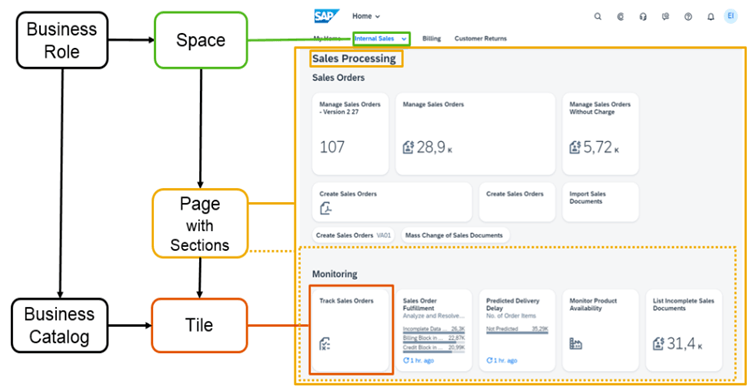
SAP Fiori Launchpad has introduced a significant enhancement by replacing groups with spaces and pages. This new UI paradigm offers a more organized and intuitive way for users to access applications and content within the Fiori Launchpad. This blog will comprehend what spaces and pages are, their relevance in the interface, benefits over the previous group-based approach, and a general overview of items available on the Fiori Launchpad.
Spaces and pages are structural elements introduced in the new UI design of SAP Fiori Launchpad. A space can be thought as a container that groups related content and applications. Within each space, you have multiple pages, which serve as navigational units to categorize and organize content.
Spaces and pages allows users to navigate through different levels of content easily. For example, a space can represent a department within an organization (such as HR, Finance, Sales), while pages within that space can represent specific topics or workflows related to that department.
The shift from groups to spaces and pages offers several advantages. One key benefit is improved organization and categorization of content. Users can now have a more structured view of applications and information, making it easier to locate and access relevant resources. Additionally, spaces and pages provide a scalable framework that can accommodate growing content without cluttering the interface.
The new UI of SAP Fiori Launchpad with spaces and pages contributes to an enhanced user experience. Users can customize their spaces and pages based on their preferences and assigned job roles, creating a personalized workspace tailored to their needs. This level of customization may increase productivity and efficiency by allowing access to critical applications and data.

"Accounts Payable" and "Sales Management" are business roles that are assigned to the user therefore "Spaces"
Under "Accounts Payable" there are pages; "Supplier Invoice" and "Purchasing Rebates"
In addition to spaces and pages, the Fiori Launchpad offers various other elements such as tiles, apps, and notifications. Tiles serve as entry points to applications or specific functionalities, providing a visually appealing and interactive way for users to launch tasks. Apps represent individual applications that users can access within the Launchpad, offering a seamless integration of different SAP and third-party applications.
The introduction of spaces and pages in the SAP Fiori Launchpad is a big step towards enhancing usability, organization, and personalization. By leveraging these structural elements along with tiles, apps, and notifications, SAP Fiori empowers users with a modern and intuitive interface that supports productivity, efficiency, and a delightful user experience.
SAP Fiori Consulting
SAP Fiori Consultant Özge Yılgür is an SAP consultant at MDP Group specialized in SAP Fiori and SAPUI5. She develops custom UI5 applications on S/4HANA using OData and CDS services. She delivers Clean Core–compliant solutions and designs cloud architectures with SAP BTP, Fiori Elements, and CAP. She assumes end-to-end responsibility in international projects.
Domain-driven Design Approach for SAP Integration
What is SAP Integration? SAP integration is the integration that takes place within SAP itself or between SAP and 3rd party systems. SAP Integration...
Groovy Scripting in SAP Integration Suite
What is Groovy and Groovy Script?Groovy is a versatile and powerful language for the Java platform. It has static-typing and static compilation...
Smart Data Sharing with SAP Integration Suite
In today’s digital world, data is at the heart of everything. But simply owning data is no longer enough. Sharing the right data, with the right...
Qwen3.5: Native Multimodal AI for Reasoning, Coding, and Agents
Introduction Qwen3.5 signals a new standard for multimodal AI agents with its native multimodal design, efficient MoE architecture, and strong agent...
ATC Check for ABAP Cloud
During the transition from the on-premise environment to the cloud, core capabilities that enable cloud-based use of ATC to ensure centralized ABAP...
SAP Quality Management and SAP EWM Integration
What is Quality Management (QM)?SAP Quality Management (QM) is a part of SAP ECC (ERP Central Component) which is mainly used to help businesses...
Process Modeling with QuickModel in SAP Signavio Process Manager
The QuickModel feature in the SAP Signavio Process Manager solution is a tool that enables the creation of a process flow model dynamically within...
Security Management in SAP Fiori Applications
In this blog post, we'll cover how users ensure security in their SAP Fiori applications.What is SAP Fiori?SAP Fiori is a user experience and design...
RISE with SAP: SAP’s Business Transformation as a Service
The need for digital transformation is here and it’s urgent. Countless businesses are experiencing a vital need to adapt and transform. But digital...
Your mail has been sent successfully. You will be contacted as soon as possible.
Your message could not be delivered! Please try again later.