

Blog

Beyond Single Retrieval: When Embeddings Hit a LIMIT

Even the largest embedding models can hit a hard mathematical ceiling, not because of weak training or insufficient data, but because a single fixed-dimensional vector cannot represent all possible relevance patterns. When retrieval needs different combinations of documents across many queries, the geometry simply runs out of capacity. This article unpacks where that limit comes from, and what retrieval architectures can move beyond it. 

The promise, and the hidden constraint

Embedding based retrieval is the default foundation of modern search, semantic discovery, and Retrieval Augmented Generation. The idea is simple: map queries and documents into a shared vector space, then retrieve them from nearest neighbors. It works incredibly well, which is why it is everywhere. But there is a catch that is not about better training data, bigger backbones, or more GPUs. It is about representational capacity. Weller, Boratko, Naim, and Lee (Google DeepMind and Johns Hopkins) formalize a fundamental limit of single vector embedding retrieval: for a fixed embedding dimension d, there are only so many distinct top k result sets that can be realized by any similarity search geometry. Past a certain combinatorial complexity, some “correct” retrieval outcomes become impossible, even under perfect optimization.   

The core theory: when dimensionality becomes a cage

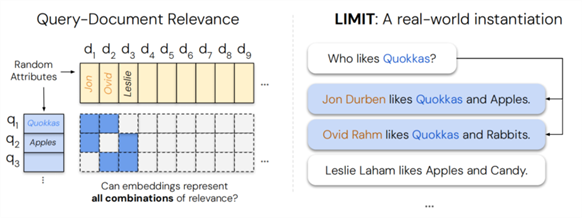
A single vector retriever represents every document as one point in d dimensional space, and every query as another point in that same space. Ranking is induced by a similar function. The key insight in the paper is that this geometric setup cannot express arbitrary relevance patterns. The authors connect retrieval expressivity to classic learning theory and communication complexity and show that the number of distinct top k subsets a model can return is bounded by the embedding dimension.   Why this matters: real retrieval is not just “is this document relevant?” it is “which combination of documents should appear together in the top k for this query.” As the number of queries grows and relevance becomes more compositional, the number of required distinct top k sets grows rapidly. At some point, geometry runs out of the room. Crucially, the authors show the phenomenon already appears even for k = 2. In other words, the ceiling is not only about retrieving dozens of passages; but it can also show up when the task needs just the right pair.   

LIMIT: a stress test that breaks strong models with simple language 

 
LIMIT_ a stress test that breaks strong models with simple language
To bridge theory and practice, the authors introduce LIMIT, a dataset designed to instantiate these hard relevance patterns in extremely simple natural language.  The “small” LIMIT setting uses 46 relevant documents and 1,000 queries.   Despite the simplicity, the paper reports that state of the art embedding models can perform poorly, with the Figure 1 caption noting recall@100 below 20 on this setup.   They also test a best-case scenario: directly optimizing embeddings on the test data itself. Even then, performance hits a critical point where the number of documents becomes too large for a given dimension, and the relationship can be modeled empirically as a polynomial function of dimension.   That is the punchline: the bottleneck is not “learnability,” it is “representability.” 

Why many benchmarks fail to reveal this 

If this limitation is fundamental, why did the field not hit a wall earlier? One reason is evaluation coverage. The paper explicitly notes that academic benchmarks test only a small fraction of the queries that could be issued, which can hide these limitations.  Many common datasets have sparse relevance structure: queries tend to map to narrow, non-overlapping regions of a corpus, which keeps the combinatorial burden low. LIMIT is constructed to do the opposite. 

What this explains in production 

This theory maps cleanly onto failure modes practitioners recognize: 
  • RAG retrieves an “average” passage that is semantically near the query, but misses the specific combination needed to answer. 
  • Multi constraint queries degrade into partial matches that satisfy none of the constraints well. 
  • Instructions like retrieval that implicitly encode logical composition become brittle as the number of distinct combinations grows. 
When a system must retrieve multiple orthogonal facts together, single vector retrieval can fail silently. The model still returns something plausible, just not the required set. 

What comes next: escaping the single vector paradigm 

The paper’s message is not “dense retrieval is dead.” It is “single vector retrieval is not universal.”  Several architectural alternatives already exist, and the paper highlights why they help. 

Multi vector, late interaction retrieval

Multi vector models represent each document with multiple vectors, often at the token level, and score via late interaction such as MaxSim, as popularized by ColBERT. Weller et al. report that multi vector models show promise on LIMIT, scoring well above single vector models even with a smaller backbone. If you want a production friendly example, BGE M3 is explicitly designed to support dense, sparse, and multi vector interaction in one model family. Tradeoff: higher memory and compute than single vector approximate nearest neighbor search, but still far cheaper than full cross encoding everything. 

Model  

Description 

Why it matters 

Main tradeoff 

ColBERT 

Late interaction multi vector retriever 

Token level matching preserves fine grained evidence (often better on compositional queries) 

Larger index and higher query compute than single vector 

ColBERTv2 (plus PLAID) 

Compressed late interaction stack 

Keeps ColBERT style gains while reducing index size and improving efficiency 

Still heavier than single vector ANN 

BGE M3 

Unified dense, sparse, and multi vector model family 

Production friendly “one model, multiple retrieval modes” for hybrid pipelines 

More infra complexity than pure dense, and multi vector mode costs more 

MUVERA 

Acceleration algorithm for multi vector retrieval 

Approximates multi vector scoring with fixed dimensional vectors so you can use standard MIPS / ANN for candidates 

Extra approximation step and rerank stage 

Cross encoders for reranking, and why they bypass the ceiling

Cross encoders score a query and a document jointly, allowing deep token level interaction. That changes the representational story. In the LIMIT small setting, the authors evaluate Gemini 2.5 Pro as a long context reranker by giving it all 46 documents and all 1,000 queries at once and reporting it solves 100 percent of queries in one forward pass.   Trade off:cross encoders are expensive, so the standard pattern remains a hybrid pipeline: fast first stage retrieval to get candidates, then cross encoder reranking for precision. 

Sparse dense hybrids, and why BM25 still matters

Sparse retrieval can be viewed as operating in an effectively very high dimensional space. The paper notes that this high dimensionality helps BM25 avoid the same problems that dense models face on LIMIT.  A pragmatic system level move is fusion: combine lexical and dense rankings, often with Reciprocal Rank Fusion.   Trade off: slightly more infra and tuning, but often a strong gain in recall for constraint heavy queries. 

Reasoning aware retrieval training

If your retrieval definition depends on reasoning rather than surface similarity, training procedures can incorporate reasoning trajectories. One example is RaDeR, which uses retrieval augmented reasoning with Monte Carlo Tree Search to generate training data for reasoning intensive retrieval and reranking.   This is not a pure fix for the single vector ceiling, but it is a clear sign of where retrieval is heading: retrieval that is conditioned on how answers are constructed, not just on static semantic proximity. 

Conclusion: the end of the single vector illusion

Weller et al. deliver a clean, mathematically grounded takeaway: under the single vector paradigm, there is a real ceiling driven by dimension, and you cannot train your way around it.   Dense embeddings remain essential for fast candidate generation and semantic generalization. But as retrieval tasks become more combinatorial and instruction driven, systems will need architectures that can express richer interactions: multi vector retrieval, sparse dense fusion, and cross encoder reranking, deployed as default building blocks rather than optional upgrades. The ceiling is real. The good news is that the path beyond it is already being built. 

References

  1. Weller, O., Boratko, M., Naim, I., & Lee, J. (2025). On the Theoretical Limitations of Embedding Based Retrieval.arXiv:2508.21038.   
  2. LIMIT dataset and code repository (Google DeepMind).  
  3. Khattab, O., & Zaharia, M. (2020). ColBERT: Efficient and Effective Passage Search via Contextualized Late Interaction over BERT.SIGIR 2020.   
  4. Chen, J. et al. (2024). M3 Embedding: Multi-Lingual, Multi-Functionality, Multi-arXiv:2402.03216.   
  5. Cormack, G. V., Clarke, C. L. A., & Buettcher, S. (2009). Reciprocal Rank Fusion outperforms Condorcet and individual rank learning methods.SIGIR 2009.   

Similar
Blog

Your mail has been sent successfully. You will be contacted as soon as possible.

Your message could not be delivered! Please try again later.