

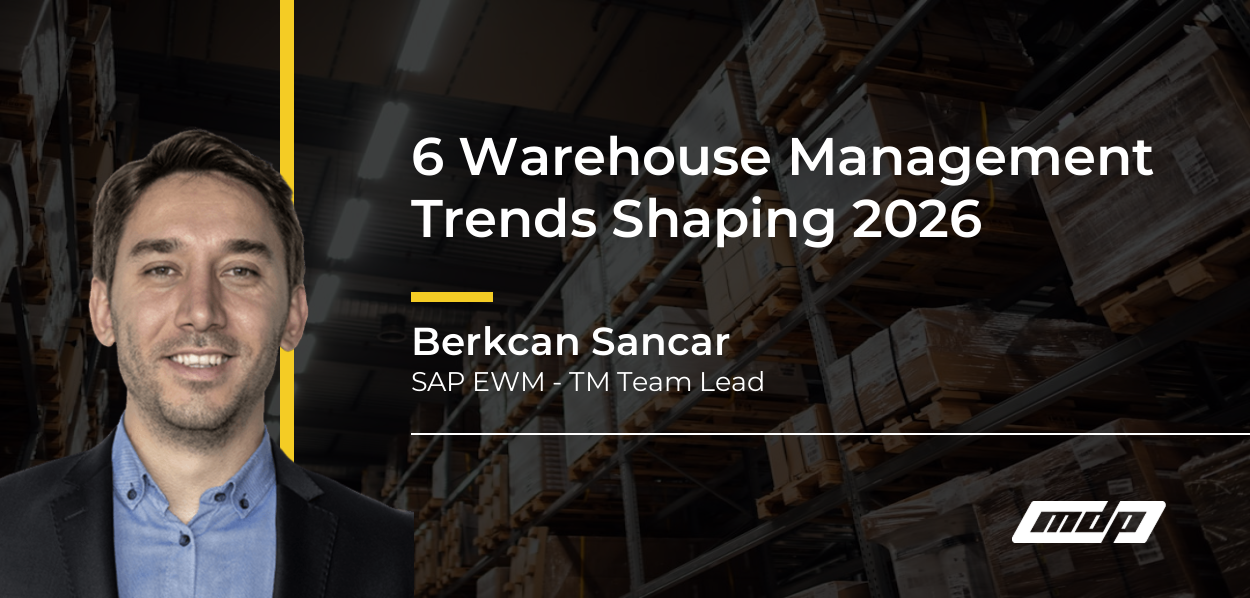
Warehouse management trends in 2026 center on AI-driven forecasting, real-time visibility, and execution-level automation. This article covers the six core trends shaping warehouse operations and how you can implement them with SAP Extended Warehouse Management (EWM).
The warehouse is the heart of every logistics operation; every step from goods receipt to dispatch takes shape there. As 2026 begins, pressure on warehouse operations keeps rising. Customers expect faster delivery, demand swings grow unpredictable, and labor shortages persist. The businesses that pull ahead make their warehouses smarter, more transparent, and more agile. The sections below map the trends driving this shift and the concrete ways to apply them.
Warehouse management trends are the technological and operational approaches that improve storage and dispatch processes in terms of efficiency, speed, and transparency. In 2026, these trends build on artificial intelligence, automation, and data-driven management.
The clearest change in 2026 is the shift of warehouse management from a reactive model to a proactive one. Classic forecasting methods look only at past sales data; next-generation AI algorithms analyze regional demand trends, seasonal cycles, and external variables together. As a result, the system detects stockout risk before it happens and adjusts capacity in advance.
AI continuously tracks SKU movements and automatically builds the most efficient slotting plans. SAP EWM warehouse automation carries this forecasting capability into high-volume outbound operations. At MDP Group, our experience shows that businesses using AI for demand planning markedly increase their stock turnover rate.
Data now sits at the center of operational strategy. In 2026, businesses turn to systems that track inventory movements, order status, and material flow in real time. The goal is not only stock tracking but also spotting disruptions early and coordinating quickly across the supply chain.
SAP EWM combines real-time inventory tracking, batch and lot management, and automatic cycle counting. As a result, the record in the system matches reality on the floor and eliminates the “assumed inventory” problem. To choose the right solution, you can review our guide on Embedded EWM vs Decentralized EWM.
In 2026, the meaning of automation takes a new shape. Instead of expensive systems that rip and replace existing processes, businesses turn to execution-level automation that works with the existing ERP environment. The aim is to improve flow without adding complexity.
Thanks to its deep ERP integration, SAP EWM embeds automation into existing business processes. The system optimizes work orders and makes task management smarter. Knowing how to automate warehouse tasks with SAP EWM helps you define the right automation scope.
Physical automation spreads rapidly as the arm of AI reaching the warehouse floor. AI-powered autonomous mobile robots (AMRs) build dynamic routes inside the warehouse and move materials without human intervention. These robots make real-time decisions to avoid obstacles.
SAP EWM supports direct control of warehouse automation equipment. Its smart storage planning rules optimize space utilization. This makes efficient collaboration between robotic systems and human labor possible. Handling Unit Management supports automation by making handling units traceable end to end.
In 2026, sustainability moved from a “nice to have” to a “must have.” Regulators, partners, and customers expect warehouses to reduce their environmental footprint. Businesses adopt energy-efficient buildings, renewable energy integration, smart lighting, and waste-reduction initiatives as the new standard.
Cloud-based, digitalized warehouse processes directly support sustainable operations through less paper, more efficient route planning, and optimized space utilization. The SAP EWM product page explains the scope of cloud-based digital warehouse processes in detail.
However far technology advances, people remain at the center of warehouse operations. In 2026, modern facilities develop their workers to use advanced systems, interpret performance data, and make informed decisions. Flexible shift planning and ergonomic improvements are also part of this approach.
SAP EWM shortens the learning curve and lowers error rates through intuitive Fiori user interfaces. A note of caution: technology investment alone is not enough; process design and worker training together drive success.
The list below summarizes the core focus of the six trends and their SAP EWM counterpart.
The most decisive trend in 2026 is AI-driven forecasting. AI combines historical data with regional and seasonal trends to predict demand before it occurs. This approach moves warehouse management from a reactive model to a proactive one and reduces stock risk.
SAP EWM combines the six trends on a single platform through real-time inventory tracking, automation-equipment control, smart storage rules, and Fiori interfaces. Its deep ERP integration brings automation into existing processes and increases operational visibility.
AI-driven automation delivers the highest return for businesses that process high order volumes, run multichannel distribution, and operate complex logistics networks. In low-volume operations the payback period can be longer; therefore volume and process analysis come first.
2026 warehouse management trends take shape at the intersection of artificial intelligence, real-time data, and people-centered design. Businesses that adapt to these trends raise efficiency, optimize costs, and keep their agility against demand swings. A strong, integrated warehouse management system sits at the foundation of this transformation. SAP EWM combines these six trends on a single integrated platform. At MDP Group, we stand by you on your warehouse transformation journey with our SAP consulting expertise. Contact us for more information.
SAP Extended Warehouse Management
ARC Advisory Group – 2026 WMS Market Trends
Made4net – WMS Trends 2026

WMS / TM / GTS / EWM Team Leader
Your mail has been sent successfully. You will be contacted as soon as possible.
Your message could not be delivered! Please try again later.