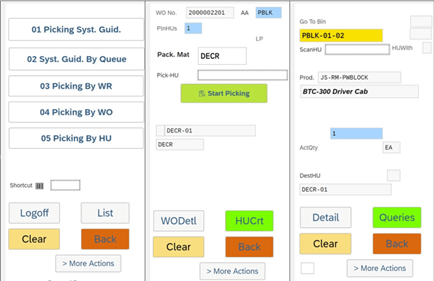
SAP offers various tools to help businesses with digital transformation and operational efficiency. In this article, we will explore two important SAP tools: EWM Mobgui and Screen Personas. Both of these tools enhance user experience and enable processes to be managed faster and more effectively.
What is EWM Mobgui?
EWM (Extended Warehouse Management) Mobgui is a mobile application interface developed by SAP for warehouse management. Designed to optimize warehouse processes, EWM Mobgui allows field workers to manage warehouse operations more quickly and accurately. This application enables warehouse staff to perform real-time data entry and track warehouse activities using mobile devices or handheld terminals. As a result, speed and accuracy increase in warehouse operations, while errors in processes are reduced.
Features of EWM Mobgui:
User-Friendly Interface
EWM Mobgui has a simplified and intuitive user interface, which allows warehouse employees to quickly adapt to the system. Easy navigation and understandable menus help users complete tasks more efficiently. Additionally, the application's mobile compatibility allows employees to track tasks from anywhere.
Real-Time Processing
EWM Mobgui processes warehouse movements in real time within the ERP system. This ensures that data such as stock levels, goods receipt, and shipping activities are continuously updated, and each transaction is recorded immediately in the system. Real-time data allows warehouse managers and staff to monitor all processes live and intervene quickly if necessary.
Handheld Terminal Applications
EWM Mobgui works on mobile devices and handheld terminals, offering flexible usage. Handheld terminals make barcode scanning and other data entry tasks faster and easier. This flexibility allows warehouse staff to work not only at their desks but also at any point in the warehouse.
Reduces Error Rates
EWM Mobgui features barcode scanning and automatic data validation. This significantly reduces the error rates caused by manual data entry. For example, barcode scanners can be used during stock counting to prevent incorrect product entries, enhancing the accuracy and efficiency of warehouse processes.
Use Cases of EWM Mobgui:
- Inventory Control: Monitoring and updating real-time stock levels.
- Goods Receipt: Quickly recording incoming products into the system.
- Shipping Management: Preparing orders and tracking shipping processes.
What is Screen Personas?
Screen Personas is a tool that allows users to customize and simplify SAP GUI screens. It aims to improve user experience and increase productivity. Using Screen Personas, SAP users can personalize system screens according to their needs, enabling them to work faster and more efficiently. In particular, user-friendly interfaces and simplified processes are key elements that enhance operational efficiency.
Advantages of Screen Personas:
Personalized Screens
Screen Personas allows users to fully personalize their screens. Users can keep only the necessary fields on their screens to access relevant information more quickly. This customization creates a more efficient work environment for each user.
Simplified Processes
SAP systems can sometimes present complex and dense information. Screen Personas eliminates unnecessary fields and processes, enabling users to focus on the information they need. This allows users to complete tasks with fewer steps and accelerates processes.
No Coding Required
Screen Personas enables screen customizations without the need for technical knowledge. Changes to screen designs can be made using a drag-and-drop method. This means that SAP users can easily customize user interfaces even without technical expertise.
Time Savings
Fewer steps in completing tasks allows users to finish their work faster. Removing unnecessary steps and simplifying screens increases workforce efficiency, enabling faster decision-making.
Use Cases of Screen Personas:
- Data Entry: Simplifying complex data entry forms.
- Reporting: Creating simple screens that display only relevant data.
- Training Processes: Reducing the learning curve for new users.